THE LONG BLUE LEADERSHIP PODCAST
Episodes

Tuesday Mar 17, 2026
Tuesday Mar 17, 2026
From combat missions in the F-22 Raptor to more than five months aboard the International Space Station, Lt. Col. Nichole “Vapor” Ayers ’11 has seen it all.
SUMMARY
In this episode of Long Blue Leadership, Col. Ayers reflects on mentorship, teamwork and building the next generation of warriors and astronauts.
SHARE THIS EPISODE
LINKEDIN | FACEBOOK
TOP 10 TAKEAWAYS
1. Leadership is fluid: sometimes you lead, sometimes you follow.On Dragon and the ISS, command shifted between Anne McClain and Takuya Onishi. Everyone alternated between being commander and flight engineer, showing that strong teams normalize moving between leading and supporting roles.
2. Team care starts with self‑care.Vapor repeatedly links sleep, rest, hydration, and health to leadership performance. You can’t be present for others if you’re exhausted or burned out; taking care of yourself is a leadership duty, not a luxury.
3. People first, mission second (to enable mission success).Whether on deployment with 300 personnel or in space with 7, she focuses on taking care of the human—family issues, logistics, burnout, and emotions—trusting that performance and mission execution follow from that.
4. Trust is built long before the crisis.ISS emergency training with all seven crew, plus years of joint training in multiple countries, builds shared understanding and trust. When emergencies happen, the crew isn’t figuring each other out for the first time.
5. Quiet, thoughtful leadership can be incredibly powerful.Takuya Onishi’s style—observant, calm, speaks only when it matters, and brings thoughtful items for others—shows that you don’t need to be loud to command respect. When he spoke, everyone listened.
6. Leadership means being fully present, especially on others’ hard days.In both combat and space, you can’t “hide” when someone’s struggling. Being reachable, attentive, and emotionally available is a core leadership behavior, not a soft add‑on.
7. Normalize mistakes and share lessons learned.From F‑22 sorties to NASA operations, it’s expected that you openly admit errors and pass on lessons so others don’t repeat them. A culture where “experience is what you get right after you need it” only works if people share that experience.
8. Plan for “seasons” of intensity, not permanent balance.She frames life as seasons: some are sprints (deployments, intense training, big trips); others are for recovery. Wise leaders anticipate these cycles, push hard when needed, then deliberately create room to reset afterward.
9. Model the behavior you want your team to adopt.If the commander is always first in, last out, everyone else feels pressure to match that. By visibly protecting her own rest and home life, she gives permission for others to do the same and avoid burnout.
10. Lean on—and be—a support system.Her twin sister, long‑term friends, and professional peers form a lifelong support network she turns to when she fails, doubts herself, or hits something “insurmountable.” Great leaders both rely on and serve as those trusted people for others.
CHAPTERS
0:00:00 – Introduction & Vapor’s Journey (Academy, F‑22, NASA)
0:00:38 – Launch Scrub, Second Attempt & What a Rocket Launch Feels Like
0:03:33 – First Moments in Space, Floating & Seeing Earth (Overview Effect)
0:06:11 – Leadership & Teamwork in Space: Roles, Trust, and Small-Crew Dynamics
0:10:19 – Multinational Crews & Leadership Lessons from Other Cultures
0:14:47 – No‑Notice F‑22 Deployment & Leading a Squadron in Combat
0:18:14 – Managing Burnout: Scheduling, Human Factors & “Crew‑10 Can Do Hard Things”
0:19:46 – Self‑Care as Team Care: Seasons of Life, Rest, and Being Present
0:26:02 – Family, Being an Aunt, and Balancing a Demanding Career
0:28:14 – Life After Space: Mentoring New Astronauts & Evolving as a Leader
ABOUT NICHOLE
BIO
U.S. Air Force Lt. Col. Nichole "Vapor" Ayers is a trailblazing pilot, leader and astronaut whose journey began at the United States Air Force Academy, where she graduated in 2011 with a degree in mathematics. An accomplished F-22 Raptor pilot, Ayers is one of the few women ever to fly the world’s most advanced stealth fighter — and she’s one of even fewer to command them in formation for combat training missions.
Col. Ayers earned her wings through years of training and operational excellence, logging over 200 flight hours in combat and playing a critical role in advancing tactical aviation. Her exceptional performance led to her selection in 2021 by NASA as a member of Astronaut Group 23, an elite class of 10 chosen from among 12,000 applicants.
As a NASA astronaut candidate, Col. Ayers completed intensive training at Johnson Space Center, which included spacewalk preparation, robotics, survival training, systems operations and Russian language. Now qualified for spaceflight, she stands on the threshold of a new chapter that led her to the International Space Station.
Throughout her career, Col. Ayers has exemplified the Academy's core values of Integrity First, Service Before Self and Excellence in All We Do. Her journey from cadet to combat aviator to astronaut is a testament to resilience, determination and a passion for pushing boundaries.
LEARN MORE ABOUT NICHOLE
NASA Astronaut Nichole Ayers
CONNECT WITH THE LONG BLUE LINE PODCAST NETWORK TEAM
Ted Robertson | Producer and Editor: Ted.Robertson@USAFA.org
Send your feedback or nominate a guest: socialmedia@usafa.org
<--->
Ryan Hall | Director: Ryan.Hall@USAFA.org
Bryan Grossman | Copy Editor: Bryan.Grossman@USAFA.org
Wyatt Hornsby | Executive Producer: Wyatt.Hornsby@USAFA.org
ALL PAST LBL EPISODES | ALL LBLPN PRODUCTIONS
AVAILABLE ON ALL MAJOR PODCAST PLATFORMS
FULL TRANSCRIPT
SPEAKERS
Host: Lt. Col. (Ret.) Naviere Walkewicz '99
Guest: Lt. Col. Nichole "Vapor" Ayers ’11
Col. Naviere Walkewicz 0:00Vapor, welcome to Long Blue Leadership. We are so thrilled you're here.
Col. Nichole “Vapor” Ayers 0:11Thank you. Thanks for having me.
Col. Naviere Walkewicz 0:12Absolutely. So the cadets get to spend some time with you at NCLS. Here the Long Blue Line is going to get to hear from you. And you know, we can actually go through the list. You know, F-22 pilot, USAFA 2011 graduate, you've been in combat, you’re a NASA pilot. The list is probably shorter what you haven't done. But, frankly, I'm just excited that you're here on Earth with us, because the last time we spoke, you called me from outer space.Col. Nichole “Vapor” Ayers 0:35Yeah, that was a lot of fun. That was a lot of chat with you then too.
Col. Naviere Walkewicz 0:38So let's just jump right in. So if we can just kind of catapult you, and let's do it in the way that they that NASA does, into space, maybe starting with the countdown, and then the Gs you take, what is that experience like? And maybe, what are some things you were thinking about in those moments?Col. Nichole “Vapor” Ayers 0:53Oh, yeah. So, you know, we launched on March 14. First attempt was March 12, and we actually scrubbed the first launch. So we got all the way down to T minus 42 minutes right before we armed the launch escape system. So that's kind of a big milestone on the countdown. We were having issues with some hydraulics in the clamp that actually holds on to the rocket wall and then let's go. We weren't quite sure whether it was gonna let go, so they scrubbed the launch then, and it was a fascinating — you don't feel like you've got a ton of adrenaline going, but, you know, you feel kind of like you're in a sim. We do some really phenomenal training. And so when you're sitting on top of the rocket, it feels like you're in a simulator, except it's breathing and living, and the valves are moving, and you can hear the propellant being loaded and all of that. And so there's a very real portion to launch date. But then, coming down off of that adrenaline, we got a day off, thankfully. We could just kind of rest and relax and then go again. So everything went smoother the second try. Of course, you know, everybody's nerves are a little less, and everything was — it just felt calmer the whole way out. But, yeah, when that countdown hits zero, I like to say you're being slingshotted off the Earth. That's how it felt. You know, in that moment, you’re going. There's over a million pounds of thrust, and it's going.
Col. Naviere Walkewicz 2:10I mean, that sounds like a lot. I can't really fathom in my mind what that feels like. Can you describe it?Col. Nichole “Vapor” Ayers 2:17You know, so I talked about in an F-22 and an afterburner takeoff, which is the most thrust that we have basically in any airplane on Earth. You know, you get set back in your seat really far. And, if you think of an airliner takeoff, you kind of get set back in your seat a little bit. Multiply that by, like, 10 or 20, and then that happened for nine minutes straight on a rocket. You're just being forcefully set back in your seat for nine minutes straight and just thrown off of the Earth, and in nine minutes, you're in orbit.Col. Naviere Walkewicz 2:49So when you had your practice, did you experience that level for that long as well?Col. Nichole “Vapor” Ayers 2:54For the simulators? So they can't that. We can't necessarily simulate the Gs in the sim. So that's like the one part that, you know, we go through the whole launch, but you're sitting at one G the whole time, and throughout the launch, you know, the Gs build, then we back off the thrust and the Gs build again, and then you have an engine cut off. And I like to explain, like, if you could visualize, like an old cartoon, and everybody's in the car driving, and Dad slams on the brakes, and everybody hits the windshield. And then he slams on the gas again, and everybody goes back to their seats. Like, that's what it felt like when the engine cut off and, you know, main engine cuts off, and then within a few seconds, the second engine lights, and you're set back in your seat again. So I like to give that visual.Col. Naviere Walkewicz 3:33That's really helpful, actually. Wow. OK, so you're there, you're in space. And I guess my first question would be, what's something that, in that moment, you're either thinking or you're just, are you still just orienting yourself? What is that like?Col. Nichole “Vapor” Ayers 3:45Oh, man, you know, we're still in the seats for the first few moments in space, and we have to open the nose cone. There's some other things that are happening on the spacecraft, and getting ready for a burn, for a phasing burn, to get up to and catch up with the International Space Station. But, you know, then eventually you get to unbuckle and get out of your seat and floating for the first time. I got out of my seat and I'm floating there. It felt like, you know, Captain Marvel when she's, like, hanging out. Yeah, that's, that's how I felt. And, you know, I like to give the visual, because it's like, it's just nothing you've ever experienced in your life, you know. And then you look out the window and the view is something, it's indescribable. You know, I don't think we have the right words in the English language to describe what it feels like to look back at Earth from space.Col. Naviere Walkewicz 4:35Was there a moment when you're looking out at Earth — did you kind of play back just different things in your life? Did you think about, you know, significance of things, or, like, scope of things, or even just the vantage point? Did it kind of just change things or were you just in awe at the moment?Col. Nichole “Vapor” Ayers 4:49No, I think, you know, we talked about the overview effect, when astronauts specifically look back at Earth, and it hits everybody kind of differently. And for me, I think the biggest thing you know, when you look at a map of the states or a map of the world, you know, every country is a different color, or every state's a different color, and there are lines that describe the borders, right? And those don't exist in in space. Those don't exist like when you can't see different colored states, right? But you can see the Grand Canyon, and you can see the mountains, and you can see the Amazon, and you can see the desert in Africa. And you get to, you know, you get to learn the world geography by colors and terrain. And it's just a really good reminder that, you know, we're all humans, and we're all on this little fragile marble, just trying to take care of each other and trying to take care of Earth. And so I think that's what hit me the most, was just there are no borders, and we're all the same.Col. Naviere Walkewicz 5:44Gosh, well, it's a unique and probably highly impressive team that you're with. I mean, we know the road to get to becoming a NASA astronaut is certainly one that is very difficult. Starts from many, many, in the 1000s, down to 10. And so, you know, when we think about leadership, and I've heard you share this before with others, you talk about teamwork and leadership, maybe explain a little bit what that's like in space when you're all so highly effective leaders. You know, what does that look like? Col. Nichole “Vapor” Ayers 6:12That's a great question. You know, I think for us, it is a very fluid movement, right? You lead one day; you follow the next. And you know, I'll give you an example. So Anne McClain was the commander of SpaceX Crew-10 for NASA. So she was in charge of Crew-10 is our ride up to the space station, and our ride home, right? It's the capsule, the rocket and the capsule. And then we were on Expedition 73 aboard the International Space Station, where Takuya, who it was, Takuya Onishi, who was our mission specialist on Dragon, soon as we crossed into the hatch and he took command. He is now the commander of the Space Station, and Anne and I are flight engineers, and so it's a pretty fluid movement in terms of leading and following. But ultimately, you know, it's just about being a good team and taking care of each other. And I think that being a good leader is taking care of other people. And, you know, we talk about team care — self-care, and team care are like the huge parts that we actually train and learn about at NASA as we go through our training, because you're on this really small space in the vacuum of space for five-plus months at a time, and it's — there are only seven people up there and everybody's going to have a bad day. We're all humans, and you can't, there's no hiding.
Col. Naviere Walkewicz 7:30What's a bad day like in space?
Col. Nichole “Vapor” Ayers 7:32People make mistakes, right? We're all human. You might make a mistake on something, you might mess up a procedure. You hope that it's not something that causes a safety incident, right? The main goal for me, at least, was, I know I'm going to make mistakes. As long as I'm not unsafe, I'll be happy. And I think that a lot of us have that conscious decision-making process. But I think that we're also humans and have Earth lives, and your Earth life doesn't stop when you go to space. And so bad days could be something going on at home. Bad days could be something going on in space. Could be an interaction that you had with somebody on the ground that, you know, there's a lot of communication that happens between us on the ground. There are thousands of humans on the Earth that keep the Space Station running. So that day could be anything but it’s tough to hide up there. Here, you can kind of like, duck and cover and maybe you just spend the day in an office. But it doesn't happen up there. We have to continue to work and continue to function.Col. Naviere Walkewicz 8:32So you mentioned that there are seven of you in this tight space. Now, when you go up there, your crew, is it the same seven?
Col. Nichole “Vapor” Ayers 8:38For the majority of the time.
Col. Naviere Walkewicz 8:42OK, excellent. So one of the things we think about whenever we're leading or we're working with teams is trust, and obviously you have a great amount of trust with the crew that you're going up there with. But then you mentioned you went on to the ISS and you're working with others. What does that look like when it's someone maybe you haven't worked as closely with in a really important mission?Col. Nichole “Vapor” Ayers 9:03So for the seven expedition members, we actually do train together for a little bit of it, not nearly as closely as, you know, the four of us training for Dragon mission. But because the most dynamic parts are launch and landing, we do a lot of training together, just as the four of us, but we train all over the world. So we go to Japan and Germany and Canada, and we go to, you know, Hawthorne, California, and we go to Russia, and we train with them, and we learn about the Russian segment, and we train with our fellow cosmonauts there. And we do emergency training specifically all together, because it takes all seven of us in an emergency doing the right thing and knowing everybody's roles. And so we train that together as well. And then anytime you're in the same country or same city together, then you get to spend the time outside of the training to get to know each other. And so you actually know your crew fairly well. But obviously, everybody's from a different nation. And we had Americans, we had a Japanese astronaut, we had Russians, so you learn everybody's culture, and it's actually, you know, to your point on being in that small — and not necessarily knowing everybody. There's also a cultural aspect; we get to know each other. We get to learn about other people's cultures and figure out how to communicate and live and work, even across the whole world.Col. Naviere Walkewicz 10:19What was something that you learned from another culture of astronaut, maybe in the leadership realm, or just something that you took away, that's really something that surprised me, or like to emulate?Col. Nichole “Vapor” Ayers 10:30I love Taku’s leadership style. So Takuya Onishi — he's one of those more quiet humans, and he's super kind, but he is the most intelligent human I've ever met, and he is super-efficient with everything he does, and he pays attention to all of the little things. And so he only speaks up when he thinks something needs to be changed, or when he thinks that, like, we need to go in a different direction, otherwise, he's pretty happy to let you go, like, let you go as far as you want to go on something. And then when he thinks you're gonna run off a cliff, he pulls you back. So when he speaks, everybody listens. And I love that. I think some of that is cultural, obviously, him being from Japan, but I think it's also just his personal leadership style, but I learned a ton from him in terms of how to interact with people, how to let people be themselves, but also how to run a ship, and everybody knew exactly who was running the ship.Col. Naviere Walkewicz 11:22Wow. And it shows that respect lens that you're just kind of talking about when he spoke. Everybody listens. Is that something that you feel you already had that kind of leadership style or is that something that you've kind of evolved in yourself?Col. Nichole “Vapor” Ayers 11:37I like to think that that's the way that I lead. That's kind of how I try to be a leader. But we're not perfect, right? Nobody's perfect. And watching him, you know, taking notes from how he interacted with everybody, the things that he thought of, the things that he brought with him for us on station, you know, we get a very limited amount of stuff, personal things that we get to bring with us. And he brought things for the crew that were like, huge milestones for professional careers. You know, just the attention to detail on the human beings around him was pretty phenomenal. So it's one of the things I'm working on to be better at, because I like to think I'm good at it. But I saw the master work.Col. Naviere Walkewicz 12:18I love that. And something you said about him, he always has attention to detail, and he saw the little things. He paid attention to the little things. I remember a past conversation we had. You had a little nugget from Col. Nick Hague, also USAFA — ’98 I believe. And I think he said to you, something about, you know, “Nicole, don't forget that you're squishy,” or something like that. And so have you had more of those moments in there where they're like little nuggets or little moments that actually give you a big return or big lessons in your life?Col. Nichole “Vapor” Ayers 12:46Oh, definitely, yeah, that one's a funny one, because the space station is metal. Everything is metal, and it's hard and so we still have weight, well, mass. We still have mass. We don't have weight, right, because we're in microgravity. But if you're cooking around a corner and you run into a handrail, it's gonna hurt, you know, if you imagine going 10 or 15 mph into something metal, it's gonna hurt — you're squishy. So that was a great lesson in slowing down and making sure you're watching your surroundings. But one of the things that Anne McClain says that cracks me up, but every time it happens, like, “Yep, this is definitely—," she says, “Experience is that thing you learn right after you need it.” And so we had a lot of those moments where you learn a lesson and you're like, “Ah, I wish I knew that five minutes ago.” And so that's something that applies everywhere. Experience is that thing you always needed right before that happened. But we also like to say Crew-10 can do hard things. That's another thing that was just kind of our motto, whether it's training — some of the training can be really physically demanding. It's really mentally demanding. And it's a lot of travel. When you get assigned to a mission, it's probably a year and a half to two years of training, and then you're gone for six months. So out of that two to two and a half years, you're not home for over a year. So you're all over the world, traveling to train and work. And like I said, we're all humans. We have Earth lives, we have homes, you get situations back home. And so navigating personal lives, navigating professional lives, navigating tough training. Crew-10 can do hard things. We like to say that.Col. Naviere Walkewicz 14:22I like that. It also talks a bit about your grit. Crew-10 grit. So, talking about hard things, I'd like to take us to the time when you've been piloting the F-22 and you've seen combat. I heard you speaking a little bit before about a no-notice deployment. Let's visit that time in your life. What were you doing? What was your role, and what was something you experienced? Col. Nichole “Vapor” Ayers 14:47Sure. So I was actually flying the day that we got notified. And, you know, just a standard training sortie — had landed, and some of the maintainers were like, “Hey, have you heard what's happening?” And I was like, “No, what's happening?” And then we had a big squadron meeting, and that's when we got notified, like, “Hey, we're deploying.” We were on the GRF, is what it was called at the time, Global Response Force, and I think some of that structure has changed since I left that squadron, but we knew that once we were on the GRF, there was a chance that we would get activated and get moved somewhere. Didn't necessarily expect it to be quite that quick. I think it was like the next week we got this deployment. So we got notified on a Thursday, I think, and then on Monday, I was taking off.
Col. Naviere Walkewicz 15:31Oh, really no notice.
Col. Nichole “Vapor” Ayers 15:33Yeah, so, four days later, we were taking off, and then seven days later, we were flying missions from — we were stationed at Al Udeid Air Base, so we're flying out of Al Udeid within a week.
Col. Naviere Walkewicz 15:45How many with you?
Col. Nichole “Vapor” Ayers 15:47So when we deploy, we actually deploy with our maintenance squadrons, 300 people. Twenty to 30 of them are the pilots, and then the rest are the maintainers. And so it's the entire squadron. We morph into an expeditionary squadron. And so there are 300 people that head out.Col. Naviere Walkewicz 16:03So I imagine, you know, on top of the fact that it was such a rapid movement, there's probably things that people had to obviously work through family. This needs to happen. But what were some things that you experienced in that deployment, or even in just that transition?Col. Nichole “Vapor” Ayers 16:21Again, I go back to taking care of people. I was a flight commander at the time. We had two flight commanders, so I'm in charge of basically half the squadron, and we had a really wonderful commander who gave us the authority and the autonomy to leave the squadron. So, you know, it's about saying, like, “How are you guys doing at home?” Half our squadron didn't even have tan flight suits. You know, we're trying, we're working with logistics. We're trying to get everything ready. Like, does everybody have a go bag? Does everybody even know what a go bag is? Do you have the things you need? So working all of that. And then do you have the childcare figured out? Do you have the — how is all your family doing? Are you ready for this? And then we had to do a bunch of last-minute training before we left. And so it's a really busy time, but it was one of the first times where I felt like I had an influence on the people that were under me, that I had supervised. And so it was a really great experience to solve those problems, figure it out and help people get off the ground in four days successfully, and leaving something, some semblance of structure at home.Col. Naviere Walkewicz 17:24So you said it was the first time where you kind of really felt that you had that impact. What would you say kind of maybe crystallized within yourself in learning that?Col. Nichole “Vapor” Ayers 17:36I think it really solidified. I think I said, “I try to lead by taking care of people,” right? I truly believe if you take care of the human, they're going to do a really great job. You don't have to ask much of people at work and in their professional life, if their personal and the human side of them is taken care of and so that's kind of what I mean when I say that solidified it for me, like, make sure that the humans are good to go, and they'll go do anything you want to do. Col. Naviere Walkewicz 18:04Wow. So while on that deployment, you're leading half of that squadron. What were some of the challenges maybe that you experienced, and how did you grow as a leader during that timeframe?Col. Nichole “Vapor” Ayers 18:14Scheduling is definitely a tough one. So we flew daytime and nighttime. We basically had an F-22 airborne for almost 24 hours a day for the entire six months, six and a half months. We left and we were told it might be two- or three-month deployment, and then it turned into six months. And then we got delayed up coming home. And so then we stayed through Christmas. And those are the things that really are tough for people. But we have a limited number of jets that we took. We have a limited number of pilots; we have a limited number of maintainers and parts. And so I think for us, managing a schedule between me and the other flight commander, managing a schedule, managing quality of life for everybody, and make sure that we're not burning people out, or that they're not —we're flying eight-, nine-, 10-hour sorties, right? And that's exhausting. It's just you and that airplane with your wingman and a different airplane. And so you have to manage, again, that human factor. The human capital is probably the toughest thing to manage.Col. Naviere Walkewicz 19:15Wow, and you talked about how the deployment kind of got extended. What were some things, because many of our listeners and our viewers are leaders, and at different levels of leadership and different times in their lives where they're doing that. When you were leading, and you had some of those subordinates, or those that were working with you that really experienced some troubles, through emotions, through some of that. How did you help navigate them through that when you were all in that as well?Col. Nichole “Vapor” Ayers 19:46Right. You know, I think at NASA especially, we talk about self-care being a huge part of team care. And so making sure I do this in my regular life too, but, you know, making sure that you're getting enough rest, making sure that you're taking care of yourself and your personal life, so that you can truly be present for the other people that need you. And I think being present for others is one of the biggest things that you can do. You know, they may not need a ton of help, or they may not need the solution, but being there, being available and being present for people is really important. But you can't do that unless you're good to go yourself.Col. Naviere Walkewicz 20:18Did you see that from someone? Did you learn that from someone you saw doing that? Or just, how did, I mean NASA's — you said, NASA, but did you see that at the Academy? Or where did you kind of gather that?Col. Nichole “Vapor” Ayers 20:28You know, I think one of the things that hit me hard about showing up and being present was actually more professional. I kind of skated through the Academy on minimal sleep, and I was able to manage everything. But I wasn't flying a $143 million airplane. And so, in pilot training, we started to talk about crew rest and pilot rest. That's the first time that I had heard this concept of, “You need to go home and get rest so that you can be on your game.” Because flying airplanes, your decisions have real consequences, right? And you have to be present and available, and you have to be on your game to fly airplanes and do well in airplanes. And then the faster and the higher and the better the airplane gets, the more on your game you have to be. So I think it's something that has just kind of evolved in me. And then, as a leader, I realized, if you don't have any gas in the tank, you cannot help somebody else. And so for me, it's just kind of been, over the last decade and a half, of, wow, I need my sleep. I need to make sure I'm good to go. I need to make sure my human is good, so that way I can help other humans. And yeah, when your decisions have real consequences, it's important that you're present and you're ready to go.Col. Naviere Walkewicz 21:43Have you seen some of the fact that you prioritize that for yourself, for you as your own human? Have you seen others kind of like see that, view that, and actually take that on as well themselves.Col. Nichole “Vapor” Ayers 21:53Yeah, I think they do. And I think, as a leader, it's really important to set that example. The commander cannot be the first one in last one out. Like, you just can't do that, because everybody's going to stay until you leave. So setting the example, setting the example of having a good home-life balance as well. Like, home and work have to be balanced. Sleep has to be balanced. Again, self-care is the biggest part of team care, I think. And if you model that, people start to realize it's important. You know, the younger people that might burn themselves out trying to get somewhere, trying to get to the next step, or trying to impress somebody, or whatever the case may be, if they see you taking a step back and they see your success, maybe then they can start worrying about themselves too. Col. Naviere Walkewicz 22:34I think that's a great lesson, leading by example. For sure. There are probably moments that you experience both at the Academy, while flying the F-22 or as an astronaut, where you don't have the luxury of balance. How do you navigate that and how do you help others get to that space maybe quicker?Col. Nichole “Vapor” Ayers 22:53I think of everything as a season in life. It might just be a busy season, and you might just have to put some time in but making sure that you are planning ahead and know that you're gonna be able to take some time and reset. And that could be anything, right? That could be personal life, professional life. That could be the four-week training trip that we've got is going to be rough, and its multiple time zones, and it's a ton of training, it's a ton of information. You just have to get through it. But then, that week, when we got home, I made sure my schedule was a little lighter. Whatever the balance is, I think of things in seasons. Crew-10 can do hard things, right? And that came from — you can get through this next training session, right? But we're gonna do a mask-to-suit transition, which is like in a fire, you've got a mask on. You have to get from that mask into your spacesuit. It's a significant physical event. And there's limited oxygen; there's limited ability to breathe in the suit when in that specific environment. And so how do you slow down, take the breaths you need to get in there to not then get to a point where you're panicking, right? Or that you're too exhausted or too hot or overdid, or whatever it is, right? So I think even just that, that is a season. We're going to do two hours of this. That's my season, and then we'll get out of the simulator, we'll take a break, right? And if it happened on orbit, it would be like, “We're going to get through this. We're going to solve the problem. We're going to manage the emergency, and then once things are set, we'll have a moment to breathe.” So that's kind of how I think of it.
Col. Naviere Walkewicz 24:21Did seasons come something, a term that you kind of realized maybe at the Academy, you were a volleyball athlete at the Academy, and so volleyball has a season. But my question is, like, how did you come to that realization? Like, “Oh, I can get through this, and I put it in a bucket of time.”Col. Nichole “Vapor” Ayers 24:35You learn a lot of time management at the Academy, and when you're in the fall, you're really busy, spring season is less busy, and so you kind of learn early how to manage. Like, “OK, I’ve got to run. I gotta sprint,” right? “And then I can jog later, or I can walk later.” So, I think you learn that growing up in school, and you know, if you play sports or you do extracurricular activities or other things like that, or even just seasons in life at home, life ebbs and flows. I don't even know when I started saying it, but my sister and I started saying “seasons of life” to each other a long time ago. You know, she's got three kiddos, so she's been in all sorts of seasons. But, yeah, it's just, you know, I think I started to time block things, or block things off and just, and that's the only way you're going to get through life, is if you focus on what you need to do right now, be good at it, and then move to the next thing. You can have an idea of what's coming next, but you have to be present and do what you're doing there. Yes, so, yeah, seasons, time, blocks, whatever you want to call it. Col. Naviere Walkewicz 25:39I like that. Well, you brought up your sister, and so you're an auntie of three. Let's talk about your personal life and leadership, some experiences you've had navigating your schedule. You're on the road so much. How do you prioritize? I guess the things that are important to you when you have such a heavy schedule, yeah, being on the road and the people that are important to you, right?Col. Nichole “Vapor” Ayers 26:03Man, I think that for me, my family has been a huge support system my whole life. My twin sister — built in best friend.
Col. Naviere Walkewicz 26:13And who is older?
Col. Nichole “Vapor” Ayers 26:14She is. She's got me by a minute.
Col. Naviere Walkewicz 26:18OK. Does she hold that over you?
Col. Nichole “Vapor” Ayers 26:20Yes, of course she does. We've just always supported each other 100% and everything. She's been my biggest cheerleader through all of my life, and I've been her biggest cheerleader through all of her life. And you know, my main goal in life is to be the coolest auntie, like the best auntie, and I would die happy. And they're a huge priority to me. I see them every couple two to three months — since my oldest has was born. So for the last 14 years, just made it a priority, even if it's like, leave late on a Friday night and then get home late Sunday night, I make the effort to go see them and to interact with them. And you know, to help foster them. You know they're growing up. And I love watching kids grow up and experience the world and see what can be done. Their dad's a Marine, their mom's this really successful real estate agent, their auntie’ a pilot-slash-astronaut. You know, they've got, like, all these no family that's really not doing very much. Yeah, you know, they'vegot all these really great role models. And my goal is to just show them that it doesn't matter who you are, like they only ever know me as auntie. Like they know I'm an astronaut, and they love that. Their friends know that I'm an astronaut. Anti vapor, no, no, yeah. But, you know, like, they're always gonna get a big hug from auntie, like, that's, that's what's important to me.Col. Naviere Walkewicz 27:36Well, you mentioned, going into space, being an auntie. So, would you describe your time and space is, it's probably out of this world. I mean, that's, wow, that's terrible. That's terrible I said it that way. But I think you've mentioned it is kind of the best time in your life.Col. Nichole “Vapor” Ayers 27:52Yeah. Best five months my life.
Col. Naviere Walkewicz 27:56Best five months of your life, and it's passed. Now, when we think about our evolution, whether personally, professionally, as leaders, etc., we have these ideas in our mind, like, this is the pinnacle. How do you navigate what's next after you've experienced that pinnacle?Col. Nichole “Vapor” Ayers 28:14Yeah, that's a great question, and I think it's something that a lot of us struggle with when we come home. What's next? We get six months, some time to think and kind of get reintegrated. And you don't necessarily have to go back to work right away. I was able to spend a ton of time with my sister and her kiddos. Yeah, what's next. And I think for me, like the drive out to the launch pad, I was like, “Man, I've made it.” You know, the first time I looked out the window from Dragon, “I've made it.” First time we crossed the hatch, and I went and looked out the glass like, “Wow. The hard work paid off.” And I still feel like that to this day. I would have spent four more months in space if they had asked me to, and I would have turned around and launched right back then the day that we landed, and it was because of the crewmates that I spent it with and the fulfillment that I got from the mission. But I think you can find fulfillment in a lot of ways. And you know, my job, now that I've been back, I'm going to be working with the new class of astronauts and their training for spacewalk. So in the Neutral Buoyancy Lab, our big pool, like, my job is to be their mentor as they go through the spacewalk training. And you know, like, I cannot wait. I'm so excited. I cannot wait to have an impact and try to help teach this next generation of spacewalkers, this next generation of astronauts, to be better than us. I find a lot of fulfillment in making the next generation better. So I think, however the fulfillment shows up for people, I think as long as you can find something, there you'll be happy. Going to space was great, but teaching and instructing and mentoring is also really fulfilling for me.Col. Naviere Walkewicz 29:54And that will be 10 of them? How many will that be?
Col. Nichole “Vapor” Ayers 29:55Ten.
Col. Naviere Walkewicz 29:56Ten. So then you'll have 13. You'll be auntie to 13. Oh, that's wonderful. What have you learned about yourself since then? You know, you've evolved as a leader through different situations, high threat, high risk. Safety is paramount. All of those different experiences. And now you're back on Earth and you're about to, you know, mentor. How have you evolved your leadership, and where would you say you're trying to go?Col. Nichole “Vapor” Ayers 30:23Where am I trying to go? I think, for me, leadership is also about being vulnerable and being open and honest with people about failures or hardships and so, you know, like in the flying community, if you make a mistake, you're immediately like, “Hey, I messed this up. Here's how we fix it.” And that's something that we do at NASA as well, especially on a grand scale, right? Thousands of employees and everybody like, that's the only way that we get to space is by admitting when we've made mistakes, talking to each other about how we fix it and sharing those lessons learned. And so I think that especially when you get into the higher roles of leadership, it's important to go, “Hey, I messed up,” or, “Hey, I don't know the answer.” And being transparent with the people that you're working with. And if you don't know it, but you know where to go find it, like, “I'll get that answer for you,” instead of making up an answer, trying to figure out how to look like you're in charge, right? It's really important to me to also show that we don't know everything. We're human. We make mistakes, and it's OK to make mistakes, as long as you share it, and you share the lessons learned, and you make the next person better.Col. Naviere Walkewicz 31:32Did you experience that personally? Did you have a moment in which you had to say, “Hey, I made a mistake,” and that's helped you realize that being vulnerable is really important or is that just something you've seen done really well?Col. Nichole “Vapor” Ayers 31:40Oh, I've admitted a lot of mistakes. You know, I made a couple pretty big mistakes in the Raptor. Everybody's gonna make a big mistake at some point in their life. And, you know, I think that that was something that was modeled really well in the flying community early on. And it's something that's not tolerated if you're not willing to share your lessons learned. It's not tolerated in that community. That’s a really good thing. I learned that in pilot training, right? If your buddy in your class makes the same mistake the next day that you made, you get in trouble because you didn't tell them how to how to prepare. And so it's fostered early on, especially in the flying community. I can't speak to any other community because I grew up there, but it's fostered early on, and so it's just something that comes naturally. I think eventually, because you just, you've seen it done so many times, and if you want other people to succeed, you're going to do it.Col. Naviere Walkewicz 32:29All right. Well, we have two questions left. The first one is, what's something you do every day to be a better leader?Col. Nichole “Vapor” Ayers 32:37That's a good one. This is gonna sound silly, but I sleep. Like, I'll go back to the self-care thing, right? Like, I put a lot of attention into being healthy, being hydrated, sleeping well. Like, if you take care of your body, your mind is going to do way more for you. And so I think you can show up as a better leader if you show up, rested, hydrated, fed, worked out whatever you need to do to be the best human you can be.Col. Naviere Walkewicz 33:09That's what I try to do. OK. I like that a lot, and I think that's a good indication for me that six hours is probably not enough. Naviere needs a little bit more. And it's truth, because you told me, though I'm gonna do that. The second one is, if you could go back in time, maybe what's something you would have told yourself — your younger self — or maybe, as our cadets are listening, that you've learned and what they can be doing now to be a better leader down the road.Col. Nichole “Vapor” Ayers 33:34If you run into a hardship or you fail at something, or something feels insurmountable, or you don't feel like you're ready, good enough, or whatever the case may be, doubt starts to seep in, right? I would say, rely on the support system that you have. Rely on the people around you. Talk about it. Figure out, you know, “Hey, I failed this GR, like, man, this kind of sucks.” And you know, maybe you just need to hear me say it out loud, and maybe I just need to get it off my chest, or maybe I need help trying to figure out the solution for whatever the case may be. So, you know, I had a built-in team on the volleyball team. I had a built-in friends and teammates that I could lean on. Maybe that's your squadronmates or your classmates, or whoever it is, right? And I think finding the friends that you can rely on for the rest of your life. Professionally, I've got a friend here that I met in the F-22 community. We've been friends for almost a decade now, and he's still one of the first people that I call when something happens, like, “Oh, I messed this up today. Help.” So, you know, finding a support system. My sister's the other person that I call first off.
Col. Naviere Walkewicz 34:38She probably knows you're gonna call when you call.
Col. Nichole “Vapor” Ayers 34:39Yeah, we talk way too much. But, you know, having that support system around you and finding people that really bolster you and get you across that line and help you find the courage to take the next step, I think that's really important.Col. Naviere Walkewicz 34:54I know I said there was only two, but as I've listened to you, I just think you're just you're just remarkable, and maybe what's something that you're proud about yourself as a leader. I would really love to hear that in your, you know—Col. Nichole “Vapor” Ayers 35:05I think the thing that makes me the most proud as a leader is when somebody succeeds and it's something that I helped them do. I've had somebody come back and say, “Thanks for saying that.” That pushed me out the edge, you know, like, I'm really into building the next generation and make them better than us. And so if I see somebody succeeding, that's good.Col. Naviere Walkewicz 35:27Well, this has been incredible. Is there anything that we didn't cover that you would love to share with the Long Blue Line in our community?Col. Nichole “Vapor” Ayers 35:33Oh, man, the community is great. I think I would just say thank you to the community. I've gotten so much love and support from Coloradans, but also the Long Blue Line and the Air Force in general. You know, I love the community that we have. It goes right back to what I just said, right, finding a community that supports you and pushes you to do better and be better. And this is that community.Col. Naviere Walkewicz 35:55Well, Vapor, I promise I'm gonna get more sleep, and I just want to thank you for being such an incredible leader and guest here on Long Blue Leadership.
Col. Nichole “Vapor” Ayers 36:03Thanks for having me back. Absolutely.
Col. Naviere Walkewicz 36:05Thanks. You know, this conversation was really incredible with Vapor. I think some of the things that really stood out to me is just how incredible as a human she is. She brings humanity into leadership. She puts people first. She thinks about the team. She works hard. Don't forget to prioritize sleep. But I think really, some of the lessons that we can all take away can hit us all personally, because if you think about people first and taking care of them, and the fact that you have to take care of yourself too, you can go really far in leadership. So I really appreciate her today on Long Blue Leadership. And I'm Naviere Walkewicz, Class of ’99. Until next time.
KEYWORDS
Joel Neeb, Long Blue Leadership, Air Force Academy leadership, USAFA leadership, military leadership podcast, leadership development, leadership lessons, character-based leadership, leadership under pressure, leading with integrity, decision making in leadership, mentorship and leadership, values-based leadership, service before self, leadership mindset, leadership podcast interview, military leadership stories, leadership for professionals, leadership for entrepreneurs, how to be a better leader, leadership growth.
The Long Blue Line Podcast Network is presented by the U.S. Air Force Academy Association & Foundation

Tuesday Mar 03, 2026
Tuesday Mar 03, 2026
What does courage look like under fire? In captivity? In command? In service?
This edition of Long Blue Leadership was recorded on location at the U.S. Air Force Academy’s 33rd National Character and Leadership Symposium. We've explored these questions with our guests and captured the conversations for you.
Ted Robertson, Multimedia and Podcast Specialist for the Air Force Academy Association and Foundation, hosts this special episode featuring voices shaped by combat, crises and lifelong service. Their message to cadets is clear: Leadership is earned through character, and character is forged in hard moments.
- Seg. 1: Lt. Col. Mark George and C1C Jaime Snyder, officer and NCLS cadet director, respectively, set the stage for this year's NCLS and for the podcast.- Seg. 2: Senior Master Sgt. (Ret.) Israel "DT" Del Toro on courage in times of crisis. - Seg. 3: Task Force Hope developer and facilitator Maj. Tara Holmes on preparing future leaders to handle crisis before it happens.- Seg. 4: Former POW Maj. Gen. (Ret.) Edward Mechenbier ’64, on leading in circumstances out of your control. - Seg. 5: Annapolis grad and Vietnam-era aviator, Capt. (Ret.) J. Charles Plumb on how character breeds courage.
All of our guest’s lives and careers reflect the reality of this year’s theme through combat, crisis and service.
CONNECT WITH THE LONG BLUE LINE PODCAST NETWORK TEAM
Ted Robertson | Producer and Editor: Ted.Robertson@USAFA.org
Send your feedback or nominate a guest: socialmedia@usafa.org
<--->
Ryan Hall | Director: Ryan.Hall@USAFA.org
Bryan Grossman | Copy Editor: Bryan.Grossman@USAFA.org
Wyatt Hornsby | Executive Producer: Wyatt.Hornsby@USAFA.org
ALL PAST LBL EPISODES | ALL LBLPN PRODUCTIONS
AVAILABLE ON ALL MAJOR PODCAST PLATFORMS
FULL TRANSCRIPT
OUR SPEAKERS: - Host, Ted Robertson, Multimedia and Podcast Specialist, United States Air Force Academy Association and Foundation - Seg. 1: C1C Jaime Snyder, NCLS Cadet Director; Lt. Col. Mark George, NCLS Officer - Seg. 2: Senior Master Sargent Israel Del Toro - Seg. 3: Maj. Tara Holmes, Task Force Hope - Seg. 4: Maj. Gen. (Ret.) Edward Mechenbier ’64 - Seg. 5: Capt. (Ret.) J. Charles Plumb
Ted Robertson 0:00Welcome to Long Blue Line Podcast Network coverage of the 33rd annual National Character and Leadership Symposium. I'm Ted Robertson, multimedia and podcast specialist for the Air Force Academy Association & Foundation, coming to you from Polaris Hall located here at the United States Air Force Academy. This year's symposium centers on the theme Courage to Lead in the Profession of Arms: Combat and Crisis-tested Character, where attendees and cadets will explore how courage in all its forms shapes leaders when uncertainty, fear and consequence are real. Our coverage will start with the Center for Character and Leadership Development’s Lt. Col. Mark George and NCLS director, Cadet 1st Class Jaime Snyder. They’ll set the stage not only for NCLS, but for today's coverage. Then we'll talk with four key leaders speaking at the symposium, including Senior Master Sgt. (Ret.) Israel Del Torro on keeping courageous during times of crisis. We’ll also talk with Task Force Hope developer and facilitator, Maj. Tara Holmes, on preparing leaders to handle crisis before it happens. Then, former POW, Maj. Gen. (Ret.) Edward Mechenbier, USAFA Class of ’64, on leading in circumstances out of your control. And finally, Annapolis grad and Vietnam-era aviator, Capt. (Ret.) J. Charles Plumb, on how character breeds courage. All of our guests’ lives and careers reflect the reality of this year's theme through combat, crisis and service. So I want to bring in our first two guests to help, as I said, frame the discussion today. We're going to dig in to learn what this is all about and sort of the “why” behind it. Cadet Jaime Snyder, 2026 NCLS director. Cadet Snyder, you've helped lead the organizing of the National Character and Leadership Symposium — 33rd year for this, as you know, and part of that work, you've trained cadets and permanent party. I'm going to ask you to explain permanent party, all of which helps strengthen your own public speaking and leadership communication skills. You want to kind of expound on that a bit?C1C Jaime Snyder 2:20Yes, sir. So a part of my role being in NCLS is to, one, provide the guidance, the support and resources on the cadet side to succeed. But what really makes NCLS special is that we integrate permanent party with cadets. So oftentimes me, in supporting and training permanent party, is giving them cadet perspective, because while they're over here and the Center for Character and Leadership Development, we're over there in the Cadet Wing, and I can be the mediator between both parties.Ted Robertson 2:46Let's talk a little bit about permanent party. What does that term mean? Who does that describe?C1C Jaime Snyder 2:52Oh yes. Permanent party describes the civilian and military faculty that works in the Center for Character and Leadership Development that assists with the execution of NCLS — the National Character and Leadership Symposium.Ted Robertson 3:05How big is the team behind this event every year?C1C Jaime Snyder 3:08It's kind of complex where we'll get search cadets. We'll get a large number of volunteers, approximately around 300 from the Cadet Wing. Internal staff consists of 50 cadets who work it throughout the entire year, and around 50 staff members who are permanent party who work in the Center for Character and Leadership Development.Ted Robertson 3:29I want to bring in next Lt. Col. Mark George, who is the experiential and training division chief and NCLS program director, the very fortunate man that gets to work for some incredibly talented cadets.Col. Mark George 3:43That is absolutely true. Thanks to for having us on. Cadet Snyder has done an outstanding job leading this team. I came into this a little bit late. You know, we've had some reorganization here at the Academy, and after some shuffling, I got the honor and the privilege to take over NCLS while the planning was well underway. So my job was to just make sure this train kept rolling, that people had the resources that they needed, the top cover they needed. And as Jamie said, he was training me as a permanent party member to make sure that I had the cadet perspective. And then, you know, we were moving this ball forward as we got to this event.
Ted Robertson 4:23So coming up in the podcast we’ll get to the sort of “why” and what’s at the core of NCLS. Colonel, let’s start with you. What is National Character and Leadership Symposium designed to do for cadets?
Col. Mark George 4:38Sure. The National Character and Leadership Symposium — NCLS — is designed to bring exemplars that embody the core values and the traits that we want cadets to have when they become leaders on Day 1 and inspire them to a lifetime of service.
Ted Robertson 4:57Cadet Snyder?
C1C Jaime Snyder 4:59We definitely see at USAFA, there is a clear correlation with NCLS and character development. One thing we want cadets to get out of NCLS is to further develop leaders of character who are going to join the fight in the Air Force and Space Force, and that's why I see the epitome of NCLS as it's an opportunity to hear people's perspectives as well as learn from it and apply it to their daily lives.
Ted Robertson 5:24Gentlemen, this year's theme focuses on the courage to lead in the profession of arms. Cadet Snyder, we'll start with you. How did that theme come together, and why is it especially relevant for cadets right now?C1C Jaime Snyder 5:40With our current structure at USAFA, we've had some implement of change. We recognize that the future war conflict is more prevalent than ever, and that it's important for the cadets to understand that we're changing the way we approach training, as well as what we're learning in curriculum. So this NCLS was an incredible opportunity to discuss courage when leading in the profession of arms, but furthermore, courage and crises-tested character. Which is what we're trying to further push along with what we do in training as well as what we teach in leadership.Ted Robertson 6:15You make good decisions when your character is strong. You make those decisions with integrity when your character is intact and it's strong. Would you agree with that, Colonel?Col. Mark George 6:25Absolutely. And I think Cadet Snyder hit the nail on the head that we really want the cadets to understand that the environments that they're stepping into are going to require that courage to do hard things. In my day, like we didn't necessarily think about the fight in that way. You know, we were kind of stovepiped in. And these cadets, whatever environment they may be stepping into, the next conflict is going to require a lot, a high demand of them, and their character is their foundation for that.
Ted Robertson 6:59One of the things you can say about this event is that it brings together voices from combat, crisis, athletics, academia and industry. How intentional is that mix, Cadet Snyder, and what do cadets gain from hearing such different perspectives on leadership and character?
C1C Jaime Snyder 7:18I think by hearing different perspectives, you get to see how universal courage is. When we say courage, it's not just one thing, it's also moral, social, spiritual. And by looking at different versions of courage, you can understand that there's different ways to actually apply courage. Understanding that courage is not the absence of fear, also knowing that courage is not simply being a confident individual. That it's more complex than you may define courage, and so you can then apply it that way — by looking at different perspectives.
Ted Robertson 7:53Colonel, I'll address this one to you as well.Col. Mark George 7:56Sure. Courage — we're talking about courage here, and there's a heavy focus on the combat side with this year's speakers. The thing that sticks out to me is that courage always involves a decision to do the hard thing. And that's what all of our speakers brought this year. They're showing how in different environments, whether it's in a prison cell in Hanoi or up on the Space Station or — there's a hard decision and the right thing is sometimes pretty obvious, but it doesn't mean it's easy. It does not mean it's easy to do. And so courage always involves a decision to do the right thing.Ted Robertson 8:39Cadet Snyder?C1C Jaime Snyder 8:40What he said I find to be very true — understanding that courage is not simply doing something physical, but also in a leadership role, especially — we're talking to cadets who are going to soon be commissioned officers. It's important to know that you need to make the right decision on and off the battlefield.Ted Robertson 8:58So from your perspective as a cadet — and this one is just for you, Cadet Snyder — what does it mean to help shape an event like NCLS while you’re still developing as a leader yourself?C1C Jaime Snyder 9:10What I've seen through NCLS is taking the time to relax. Don't focus on the future and focus where you're at right now, and that's character development. So don't let the pursuit of tomorrow diminish the joy today. We all have this aspiration to graduate, throw our hats in the air, Thunderbirds fly over. But right now it's important to focus on character development as that's going to be important as future officers.
Ted Robertson 9:35That makes 1,000% very clear sense. But I do want to ask you, less than 100 days from the day you toss your hat — you're giving me a big smile right now — talk about how that feels right now for you.
C1C Jaime Snyder 9:47It's incredible, and a part of it is less daunting, because I can say this institution has really prepared me to commission, and so it's more liberating than daunting for me.Ted Robertson 9:58Col. George, I'm going to direct this one straight to you, and this is an ask of you from the leadership perspective: How do we events Like NCLS fit into the broader effort to intentionally develop leaders of character here at the Academy.
Col. Mark George 10:14So I get the honor of leading the experiential and training division in the Center for Character and Leadership Development. So we're all about creating experiences and those opportunities for cadets to have different types of environments where they'll learn about character. And right now, NCLS is an opportunity to listen to where people's character was tested, how they overcame it. And then we also have different events that we try to put the cadets in where we'll actually test their character. And that could be on the challenge tower, it could be through our character labs where we're having discussions. NCLS is a huge part of that, because the planning cycle is so long.
Ted Robertson 10:59Cadet Snyder?
C1C Jaime Snyder 11:00Yes, sir. One thing I wanted to add on to that is with NCLS, one thing that makes this event the most unique experience that I've had is the fact that we get to engage in meaningful dialog. This isn't a brief. This is an experience for everyone who attends. I've had the opportunity to talk to Col. George's son, who aspires to possibly come to the Air Force Academy. So I don't want to say this is just for cadets, but it's also a promotion tool. And understand that what we do at NCLS is very important. And anyone who wants to attend can come and see what we're doing and how important it is.
Col. Mark George 11:33I want to thank you for that, by the way. He looks up to you, and that meant a lot.
Ted Robertson 11:37That's pretty visionary stuff. That's touching the next generation. That's fantastic. All right, this is for you both. When cadets look back on NCLS years from now, what do you hope they're going to remember feeling or being challenged to do differently?
C1C Jaime Snyder 11:56There is a very strong human component to NCLS, and with that, there's a human experience. Understanding that we're getting speakers and we'll see their bios that they're incredible. They have incredible stories of making the right decision when tensions were high, and getting to hear their stories and understand that they ultimately were no different than we are. Some of them were Air Force Academy graduates. Some graduated from the Naval Academy, West Point, other colleges, but they were young, 20-year-old people like we were as cadets. And so getting to understand where they're coming from, human experience is vital to NCLS, and how do we grow and understand where they're coming from?
Ted Robertson 12:38Col. George?
Col. Mark George 12:39 Yeah, I think what I would want the cadets to remember is how these speakers made them feel. You're right, you won't remember every nugget of wisdom that was said. I just had the opportunity to talk with Gen. Scott Miller, and he was an incredible leader. And I feel like everything he was saying was gold. I wish I'd been able to write it down. But he really makes you feel like you understand just how important your role is going to be as a young leader. And when you come away as second lieutenants from this place, you've had incredible opportunities and now you're stepping out in the real world. I would think I want the cadets to remember that like, “Hey, what I do matters, and how I lead is very important to getting this mission done.”
Ted Robertson 13:24Lt. Col. Mark George and C1C Jaime Snyder, officer and cadet in charge of the 33rd NCLS. Congratulations on the event. Well done, and thank you for spending time here with us on the podcast today. Hearing from both the cadet perspective and the senior leadership behind NCLS makes one thing very clear: This symposium is intentionally designed not just to inspire but to prepare future leaders for moments when character will be tested. And that brings me to my first featured guest, a man whose life story embodies what combat and crisis-tested character truly means. Israel “DT” Del Toro, welcome to the podcast. It's an honor to be with you here at the National Character and Leadership Symposium.
Senior Master Sgt. (Ret.) Israel Del Toro 14:18Thank you, Ted. Thanks for having me. Good to see you again.
Ted Robertson 14:21Yes, it's not the first time we've gotten to spend some time together. Senior Master Sgt. Israel Del Toro 14:24It's always great to talk to people, try and spread the word of the whole spark and the promise of my dad.Ted Robertson 14:30The spark and the promises are the two things that really stood out to me about that interview — your heart and your soul man, from a very, very early age.
Senior Master Sgt. Israel Del Toro 14:39 You know, losing my dad at 12, and then a year and a half later, losing my mom to a drunk driver, and being the oldest, you know, having to now kind of step up to be, like, the parent figure to my younger siblings. It was challenging.
Ted Robertson 14:55Out of all of that, you wound up as a retired — you are currently a retired senior master sergeant. You took responsibility for your siblings, as you say, after you were orphaned as a teenager, and ultimately in the service combat-wounded airmen, and you survived catastrophic injuries against incredible odds, and that did not keep you down. One of the things that you did was you became an Invictus Games gold medalist. You're now a national speaker, and you talk a lot about resilience and purpose.
Senior Master Sgt. Israel Del Toro 15:27Yes, sir. Yeah, Invictus, I won gold in shot put. It was pretty awesome. You know, everyone was just going nuts. Ted Robertson 15:37You kind of make me feel like that was a soul-feeding, motivating time for you.
Senior Master Sgt. Israel Del Toro 15:42It was. At that time, I was probably one of the senior guys, kind of. Obviously, I was one of the senior guys, wounded guys on the team, and so a lot of people looked up to me. And sometimes I wish — people would say, “Man, it's great. You're such trailblazer.” You're sometimes like, “Man, I just want to be one of the guys. I just, I just want to be No. 10.” You know, everything's all done, and no one's focusing everything on me. But it's a burden that I'm willing to carry on to try and continue to help people.
Ted Robertson 16:19I want to linger here in your background a bit, because it's more than just impressive. I think impressive is pretty trite to describe what your background is. Let's start with before the Air Force and before combat, and just how your life demanded responsibility at such a young age. And what I want to ask is, how did stepping up for your family shape the leader that you became?Senior Master Sgt. Israel Del Toro 16:40Well, I contribute that totally to my dad. I truly do. My dad was there. My dad, you know, I went everywhere with my dad. My dad — you know, he came from Mexico to this country, and he gave up a lot. You know, my family in Mexico is very wealthy, their ranchers and all that. He came here with nothing. And he always used to tell me, he's like, “Don't ever be envious of someone that's successful. Learn from them. Ask them questions.” He also used to tell me, “If you don't succeed, it's no one else's fault by yourself. Don't blame where you came from, where you grew up from, the situation. It is only your fault.” So my dad always had told me these little lessons and obviously the last lesson he gave me the night before he passed: Always take care of your family. And that just stayed with me, that kind of continued to shape me all throughout my life, all through my journey, at a young age to teenager to young adult to the military and to now, to this day, that really guided me to who I am. Now, it's like, I always hear people say, “Oh, man, I don't know if I can do it.” I was like, “Yeah, you can. You Just never know. You weren't ever put in that situation” I always believe — you always hear the fight or flight. “What are you gonna do?” I just fight, and I continue to fight. I just don't see the flight in me. And, you know, being the promise of take care of your family. Yes, I tell people, that originated with my family — my brothers and sisters. But throughout time it has evolved to now anyone I see that’s having a hard time that needs maybe to hear a story or read a book or hear a journey to help them find that spark, because I see them now as my family. I see that as my family, as my mission now.
Ted Robertson 18:50Let's stay with spark for a minute. It's just one of my favorite things that you've ever talked about. You're down, you've been badly burned, you're worried about whether you're going to survive, and a medic is helping you out, and he does something for you. He says something to you.
Senior Master Sgt. Israel Del Toro 19:07Yeah, you know, the medic — I always like to say, you know, yes, I'm Air Force. Those guys were Army, and we bust each other's chops. But, we're all brothers and sisters, and we're down range, you know? We take care of each other, we tell stories, we talk about our family. So these guys knew what had happened in my past with my family. So when I'm, you know, laying there, after I coordinate getting air, and I started the adrenaline going down, I started getting scared. I was having a hard time breathing, and I just wanted to lay down and sleep. The medic came and reminded me, “DT, remember what you promised your son, that you'll never let him grow without his dad. Fight for your son. You got to fight for your son.” And he's just making me yell it. You use anything you can to keep your guy motivated, to help that spark go, keep going. And that's what he did. He found that spark to keep me going, to keep me fighting until that medevac came and to get me on that helicopter, to the FOB, to the hospital, and then to eventually San Antonio.Ted Robertson 20:24After that injury, that's when the fight shifted. You had to get off the battlefield. You had to get that out of your head. You had to start battling for your recovery. So what did courage look like when progress seemed like it was slow and at one point nothing was guaranteed?Israel Del Toro 20:46Yeah, it, you know, when he had a shift from now being on the battlefield to now a different kind of battle and your recovery, your way of life — it's difficult because you have people telling you this is what your life's going to be. You know, being told that you're never going to walk again. You got to be in a hospital for another year and a half, respirator for the rest of your life and your military career is pretty much over. You know, I like to say there's two choices again: Who you're going to be? Are you going to take the easy path, which is, I'm going to sit in a chair, accept what they say, hate life, you know, curse the world. Are you going to take the hard path where I want to fight? I'm going to show you I can do this. I'm going to prove that I still have value, and I want to come out of this ahead and show not only my son but the rest of the world. You stay positive, you find that spark, you will come out ahead.Ted Robertson 21:48All right, last question on your background, because we're going to roll all this into why you're here and what messages you want to share with the cadets and the attendees that are here. You did something I don't think most human beings would even think about after that ordeal that you had been through all those years, everything. You reenlisted, and it wasn't just a medical milestone. It wasn't because you could, it was a conscious decision. So what internal commitment had to come first for you to make that decision.Israel Del Toro 22:22You know, I guess it was, for me it was I loved my job. I knew I could teach, I could be prepare these next guys to [be] the next generation operators.Ted Robertson 22:38You’ve never stopped being committed. You've never stopped. So it brings you to NCLS. This is the 33rd year for NCLS, and when you speak to cadets here, what message do you want them to take away with them?Senior Master Sgt. Israel Del Toro 22:53I guess my message more is about that when you're in the military, no matter whatever happens to you, you still have a role to play. Even when I got hurt, did I miss being with my teammates? Yes, but now refocusing, OK, I'm here in this hospital, and I see all these wounded guys here as I guess I'm wounded also, but in my head is like I was still NCO in the Air Force. I still have a job to do. Yes, I'm hurt, I'm wounded, but the job of a leader is, no matter where you're at, is you try and take care of your troops. You try and make things better for them, even if you never see any of the benefits — that is your role. And so that's kind of what I want to leave with these guys that, you know, you're going to always have challenges throughout your career, but you’ve always got to remember it's not about you, it's about the guys under you to take care of you. You know, I had a group of cadets yesterday and they were just asking me about leadership. So you know what? The best way to be a great leader is to earn the respect of yourtroops. If you demand it, you're not a leader, but when you earned the respect and they'll die for you, that is the greatest feeling. You know, I gave an example of one of the best moments I had after my injury, is after I got hurt, they sent my replacement, and he comes in and obviously introduce him to the scout team, to the Army company, individuals in leadership, and then the SF team, and all these guys I'm supporting. And the guy comes in like, “Hey, I'm here to replace DT.” And all of them, “You can't replace DT.” And I told that was the best moment that that's the best moment of respect, because I had Army guys saying, “He's our guy.” And that's the thing I told them, it's like, when you get to that moment when your guys say, “Nah, he's our guy,” I was like, “He can't replace him.” That is where you've truly earned the respect of your troops.
Ted Robertson 25:21Israel, the only word that I can pull out of myself right now for your journey to describe it as “remarkable,” and you continue to give of yourself, and that's a wonderful thing. Your opportunity for a couple of final thoughts here, before we close out.
Senior Master Sgt. Israel Del Toro 25:38Final thoughts, man, putting me on the spot, aren’t you. I guess my final thoughts would be, you can't do it on your own. I'm not here right now, because I did it my own. I did it. I'm never gonna say that I did. I had friends, I had family, I had my wife that were by my side all throughout my journey to medical individuals. And I had those dark times, and I'm going down that spot, that rabbit hole, they were there to pull me out of it. So I think it's like, you know, don't try and do it on your own. We all need help. You know, the goal is, don't be prideful. There's a reason pride is one of the seven deadly sins. But, you know, ask for help, ask for advice. It's not going to hurt you. If anything, it will make you stronger and better. That's parting thoughts for the individuals listening to this. Ted Robertson 26:53Perfect. Israel “DT” Del Toro, what a privilege to sit with you again. Want to say thank you from all of us for your service and continuing to lead by the example, which is a very rich and broad and deep example. Your story reminds us, and should remind us, that courage doesn't end with just survival. It always continues in service to others. Israel, thank you for being here.
Senior Master Sgt. Israel Del Toro 27:18Thanks, Ted. I appreciate it. Thanks for having me again.
Ted Robertson 27:21Israel's story reminds us that crisis and moral injury don't always arrive on a schedule, and that leaders are often expected to navigate those moments without ever having been taught how. That's where our next conversation takes us: into the intentional work of preparing leaders before crisis arrives. Maj. Tara Holmes, welcome to the podcast. It's great to have you with us as part of the National Character and Leadership Symposium.
Maj. Tara Holmes 27:46Thanks for having me; glad to be here.
Ted Robertson 27:48
You are currently deputy chief of staff here at Headquarters USAFA. You are formerly chief of cadet development for CCLD, the Center for Character and Leadership development. By way of background, you flew.
Maj. Tara Holmes 28:01
So I am a B-52 electronic warfare officer by trade, and then moved over into white jets. So instructed in the in the T-1 and I've kind of been in education and training for, I'd say, since about 2017.
Ted Robertson 28:19
You also hold a Doctorate in Business and Management, and you are an AETC master instructor. I will let you explain AETC.
Maj. Tara Holmes 28:27
Air Education Training Command, that's one of the that's our majcom that's responsible for education and training, and they have a pathway to become a master instructor. So I finished the qualifications for that while I was in white jets and working over at Squadron Officer School.
Ted Robertson 28:46
So let's talk about your work with Task Force Hope. We'll talk about what Task Force Hope is, but you are and have been a developer and facilitator of Task Force Hope, which is a crisis and moral injury leadership workshop.
Maj. Tara Holmes 29:01
Task Force Hope is about providing immediately useful tools to our workshop participants to prepare them to lead through crisis, whether that is no-kidding combat related, or whether that's crisis on the home front, going through stuff in life that's really hard. We work through a series of key concepts and exercises, through storytelling and participant engagement that hopefully provides our participants some self-awareness and some tools to recover as it deals with their relationships.
Ted Robertson 29:39
We talked about this. There's a lot of nuance in what you're teaching these people. There's discernment in it. Who should you talk to, who you should trust with information that you want to share? Because ultimately, some of this becomes a pressure release valve, right?
Maj. Tara Holmes 29:52
Yeah, so one of the key concepts that we talk about is worthiness, right? I think often people feel pressure to not share what they're going through because they don't think their problems are worthy of attention, whether theirs or someone else's. That's one thing that we spend a lot of time on. And like you said, you know, who to who to share with, and at what level, some people are more free with sharing than others, and that's OK. So we work through some frameworks that help illustrate how people can kind of work through those levels, or gain some self-awareness and some clarity around where they fall. Something that is a, you know, deep seated secret for you, maybe something that somebody else is willing to openly share, they just don't see it as that big of a deal. So it's definitely about self-awareness and learning some tools to help relieve some of the pressure and drain on our batteries, as it were, that comes from holding these things in.
Ted Robertson 30:52
People who are attending the workshop are going to learn some things that they may not realize are draining their batteries. You're teaching them to discern what those are, and to be careful to try to avoid those. It sounds like an example to me of things that we don't realize we do, that drains us, right, instead of energizes us.
Maj. Tara Holmes 31:10
So we use the kind of metaphor of a smartphone, right? So there are things that drain us, that are big, that we're taking a lot of energy to conceal the hard things that we're dealing with in our life. But then there's, like, the pesky background apps, there's the things that are always running in the background of our lives that drain our energy without us really even noticing it. You know, so for me as an officer, but also as a mom and a spouse, some of the things that are always draining my batteries are my to-do list, the laundry app, maybe social media apps. Sometimes I've probably spend way too much time reading the news these days. That's kind of always on for me. We have these big things that are draining our batteries, but then we have these like small things that are constantly going on, right? So Task Force Hope is about recognizing what those things are for us and then making a commitment to ourselves to make this space and time to recover.
Ted Robertson 32:09
So that brings us to a really unique place. You kind of function at the intersection of character, leadership and development pretty much every day. So how do you define character when you're responsible for shaping it across an entire Cadet Wing.
Maj. Tara Holmes 32:24
To me, character is the essence of who they are. It is how you show up day after day. It's the habits that you have. That's why, when you do something out of character, people are able to say that. You know, we talk about building character strengths as building blocks towards certain virtues. And virtues is really excellence of character. So it's easy to talk about how to be an excellent athlete, or how to be an excellent academic, right? And that's one of our core values, is being excellent. Well, how do you have excellent character? It's really about leveraging your character strengths in a way that can lead you to be more virtuous, and that's the goal.
Ted Robertson 33:05
You've served, both operationally and as an instructor. Tell me how those things shape the way you think about preparing leaders not just to perform but to endure.
Maj. Tara Holmes 33:19
What comes to mind is the importance of training and building those habits. We're, you know, in the previous question, we talked about it in terms of character. You know, you can, you can use any kind of training. It's about building readiness, right? And being able to build those habits so that when you are faced with a challenge, you have a way to work through the challenge, right? That really came out for me, both operationally and as an instructor. So operationally, you rely on your training to get your job done, and then as an instructor, you're helping others build those habits so that one day when your students are faced with challenges, they can rely on their training as well.
Ted Robertson 34:01
We've talked a bit about your experiences and how they shape the way you think about preparing leaders, not just to perform but to endure. And now let's bring it right down to the direct connection between Task Force Hope and why you are here talking about this program to attendees at NCLS. When we talk about Task Force Hope, it's a program that is really designed to prepare leaders to navigate crisis and recover from both emotional and moral injury. What can you tell me about a gap that a workshop like this fills, that traditional leadership education sometimes or often misses?
Maj. Tara Holmes 34:38
Task Force Hope is preventative in nature. It's training to prevent people from letting their burdens get the best of them so that they can show up. They have the tools to show up fully charged when stuff hits the van. And not only that they do that for themselves, but then they can help their teammates or their subordinates also get there. It's self-awareness, because we all perform self-care differently, and what you need to recharge your batteries is different from the way that I would do it. So it's being intentional and having some tools to be able to identify what works for you and then how to make space in your life, and building that commitment to yourself, to make that space so that the next time that you face a crisis, you're not facing it at 10%, you're full up, you're ready to go. So it's that sustained self-care, if that's what you want to call it. And it's important to say that you know, in a 75-minute session, we're really doing our best to provide exposure to key concepts and these tools. What we hope is that people walk out with the start of something. It's not it's not the end of their work to be done.
Ted Robertson 35:54
How often do you hear the question, “Why didn't I hear this earlier in my career?”
Maj. Tara Holmes 36:00
Every workshop. Last year, after the workshop, we had a 1970-something graduate say that exact thing. For me personally, I had four people say something, you know, “Hey, I was a cadet here in ’90-something, ’80-something, 2000-something. And, you know, I really wish that I would have had this earlier.” So that's what we're trying to do. We're trying to bring it as early as we can.
Ted Robertson 36:26
OK, so our last question of our visit, if cadets take just one lesson from Task Force Hope and NCLs this year, what is your hope for that lesson to be?
Maj. Tara Holmes 36:39
My hope is that they're worth it. No problem is too big or too small to be dealt with, and like we talked about earlier, I think often people keep things to themselves because they feel like they shouldn't bother others, or there's their supervisors or their teammates with what's going on in their lives. And that's a drain. Like, that's a drain on the system. It eats up your energy, right? But our cadets are worth it. Whatever they're dealing with, big or small, is worthy of being addressed. I hope that's the takeaway, and that we all deal with things, right? We don't always know what other people are dealing with.
Ted Robertson 37:22
Maj. Holmes. Thank you for the work you're doing to prepare future leaders, not just to lead in moments of clarity, but to stand firm in moments of crisis. We appreciate you being here.
Maj. Tara Holmes 37:32Thanks, Ted.
Ted Robertson 37:33
That focus on preservation, resilience and moral courage brings us to our next conversation, one shaped by combat, captivity and a life of service under the most demanding conditions. Coming up next, my conversation with Maj. Gen. (Ret.) Edward Mechenbier. Gen. Mechenbier, welcome to the podcast. It is a huge honor having you here, sir.
Maj. Gen. Edward Mechenbier 37:56
I hope you feel that way in a half hour so well,
Ted Robertson 37:59Well, the conversation does promise to be interesting, because your life is… interesting. That was a pregnant pause, sir.
Maj. Gen. Edward Mechenbier 38:07
Yeah, I've enjoyed it. It's different.
Ted Robertson 38:11
Just to sort of frame things, you retired as a major general, and what year was that, sir,
Maj. Gen. Edward Mechenbier 38:15
2004
Ted Robertson 38:16
And you were USAFA Class of ’64. You're a Vietnam-era pilot, having flown F-4s, you were shot down on your 113th combat mission, but that was you also your 80th over North Vietnam. OK, prisoner of war. Then for almost those entire six years following that, being shot down. You come with 3,600 flying hours across lots of different aircraft.
Maj. Gen. Edward Mechenbier 38:42
I was privileged fly either for primary capability or for familiarization with 43 different airplanes.
Ted Robertson 38:49
And now you describe yourself as a lifelong advocate for veterans and public service.
Maj. Gen. Edward Mechenbier 38:56
Well, yeah, I mean, I go to a couple prisons in Ohio, and “work with” is probably overstating my role. Veterans who are incarcerated for long periods of time. But my role is just to go there, spend some time, shoot the breeze with them, no agenda, no desired learning objective and let them know that somebody outside knows that they're there.
Ted Robertson 39:19
What I want to do is spend some time in your background. All right, I want to start with combat and captivity and how that tests leadership in its most extreme forms. And this is in course in keeping with the theme of NCLS here, what did character mean to you when circumstances were entirely beyond your control?
Maj. Gen. Edward Mechenbier 39:38
The Vietnamese kept us in small groups of one and two or three guys. I mean, we never really until near the end and later on when we got a little organization. But it got very down, very personal, when at one time, I was in a cell with four guys, three Class of 1964 Air Force Academy graduates and one poor Oklahoma State University graduate, and amongst the four of us, we had a senior ranking officer. And of course, you got the same rank, you go alphabetical. And so we made Ron Bliss the senior ranking officer in our room. We had a communication system. We had guidelines that, you know, which were basically consistent with the code of conduct. You know, name, rank, serial number, date of birth, don't answer further questions. Keep faith with your fellow positions. That was the key. Keep faith. Never do anything that you'd be embarrassed to tell somebody you did.
Ted Robertson 40:34
What you're explaining is how different leadership looks, and even how you describe it, how different it is from command. So now it comes down to trust and accountability and courage, and how do those show up in those conditions?
Maj. Gen. Edward Mechenbier 40:51
It was really a matter of, we always knew we were still in the fight. That was one thing that was with us, and so you just kind of conducted yourself with, OK, I'm not going to let myself be used. Now, we also knew that the more you resisted pushed back, the less likely they were to make you go meet an antiwar delegation or write a confession or do something else like that. So they tend to pick on, if you will, the low-hanging fruit or the easier guy to get to. So we always wanted to set the bar just a little bit out of their reach.
Ted Robertson 41:25
All right, having gone through all of that, it really can change people quite profoundly. So when you look back at it, what leadership lessons stayed with you long after you got out of captivity?
Maj. Gen. Edward Mechenbier 41:39
In the movie Return of Honor. Capt. Mike McGrath, Navy guy, describes the guys in their ability to resist torture and do things. And that's what you learn. Everybody's got a breaking point. If mine's here and somebody else's is there, that doesn't make me better or worse than them. So you learn to appreciate the talents and the weaknesses. If you know the foibles, the cracks in everybody around you and not to exploit them, but to understand them, and then to be the kind of leader that that they need.
Ted Robertson 42:12
Sir, one of the recurring themes when you're discussing leadership with leaders right is knowing something about each of your people so that you can relate to them in a way that that works for them and motivates them.
Maj. Gen. Edward Mechenbier 42:23
Yeah. Mark Welch, who's also a graduate and he is a chief of staff of the Air Force, always had a saying: “If you don't know what's going on, it's because you didn't ask.”
Ted Robertson 42:32
Now we're going to roll all that into your long journey between captivity and your visit here to NCLS this year. When you're speaking to the cadets at this year's event, what's your main hope? What do you hope they understand about courage before they even ever face combat?
Maj. Gen. Edward Mechenbier 42:54
Well, courage is a reaction to a clear and present threat. Nobody knows how they're gonna — know he's gonna say, OK, I'm gonna go to Vietnam and I want to get shot down, and when the Vietnamese capture me, I'm going to give them a middle finger and I'm going to be the meanest bad ass and hardest-to-break prisoner. Yeah, it's how you respond to the to the immediate perception of bodily harm or being used or something else like that. So courage is, yeah, it just happens. It's not something that you can put in a package and say, “OK, I've got courage.” It's how you respond to the situation, because you might respond quite differently than what you think.
Ted Robertson 43:35
And I have to say, you presented your story and you delivered your message in kind of a unique way. You drew from some contemporary references, specifically three clips from a movie that you like, that I was curious. How did you sum up your entire life in three movie clips from Madagascar? How did you do that?
Maj. Gen. Edward Mechenbier 43:57
Well, the three movie clips — when I watched the movie, I was looking at it, I have got two favorite movies. Madagascar is one, and the other is a Kelsey Grammer movie, Down Periscope. I mean, I think that is a perfect study in in leadership. But in the movie Madagascar, the premise was penguins can't fly, but yet it opens up with them applying resource, innovation imagination, and they eventually get this airplane to fly. OK, great. Success. Well, like everything else in life, things go wrong, and you got to have, No. 1, a backup plan, an exit ramp or a control mechanism for the disaster that's pending. So that's the second movie clip we saw. And then the third one was towards the end of the movie, when the crash landing has happened and the skipper asks for an accounting, and he's told that all passengers are accounted for, except two. And he says, that's the number I can live with. And the message there is, you go through life — you're going to have successes, but you're going to have failures, and failure has a cost, and it's not always pleasant, but that's OK, because that's life.
Ted Robertson 45:15
How do you explain how leaders can prepare themselves morally and mentally for moments they can't predict or control.
Maj. Gen. Edward Mechenbier 45:25
Watch movies like Madagascar and Down Periscope. You know, there's a breadth of unintentional, if you will, guidance on how to be a leader, if you know where to look or if you're looking for it. I mean, that's part of the whole progress program at the Academy. Nobody's going to say, OK, here's a scenario, lead these resources to a proper conclusion. It's kind of like, OK, here's the situation. What do we do? What can we do? What can't we do? It's like, in my presentation, I talk about being able to run across a pasture in nine seconds, in 10 seconds, but if the bull can do it, you're in trouble. So you got to realign your thinking, you got to realign your goals and you got to realign the application of resources. So that's the leadership part, right there. It's a realization of what you can and what you can't do. It's a realization of what you, your people, your resources, can and can't do. It's a realization of what the technology you have at your disposal to do your mission can and can't do. So it's all about workarounds and being flexible. And then the other thing is, we live in a world that just seems to be everything's got a prescription and a protocol on exactly how to do everything. Doesn't work that way. You got to be able to go left and right. You got to be able to be a little imaginative.
Ted Robertson 46:42
What parting thought did you leave the cadets with?
Maj. Gen. Edward Mechenbier 46:45
That failure is part of life. It's not death. And I'm part of an organization called American 300 — we go around and talk to young enlisted people and all the services to get them to understand that failure is a learning opportunity. It's not a dagger in the heart, and don't be afraid or ashamed to try, because if you don't, you'll never know what your true potential is. So with the cadets, we close with that last part from the movie Madagascar that basically said, OK, success comes with a price. Be aware and accept it.
Ted Robertson 47:23
All right, we've got to close it out here, but recap, if you would one more time that message that you want cadets to leave here with from having heard you speak.
Maj. Gen. Edward Mechenbier 47:32
You are now a living, breathing, viable, productive part of our United States Air Force. You bring talents that are unique. Apply them, but understand that they're all very transitory, and you have part of a larger community. If you stick with a community rather than the “I did,” “I want,” I have,” you'll go a long way.
Ted Robertson 47:54
All right, and stepping outside of that very briefly for your final thoughts, what would you like to leave listeners with today.
Maj. Gen. Edward Mechenbier 48:01
Be proud of the young men and women who are in our military now, not just those at the Air Force Academy. You know, our whole military structure has changed over the years. You know, it's a dynamic world. You got to be flexible and embrace change. We're so reluctant to change. Change is fine, except when you try to change me, is the old saying, but we all have to change. We have to be part of the world in which we live.
Ted Robertson 48:26
Gen. Mechenbier, I want to thank you from all of us for being here sharing those leadership lessons of yours and a lifetime of service that will continue to shape others — future leaders — for a very, very long time to come. We appreciate you very much.
Maj. Gen. Edward Mechenbier 48:43
Thank you much.
Ted Robertson 48:44
Our final conversation brings us to leadership at the strategic level, where decisions affect institutions, alliances and the nation itself. Capt. Charles Plumb, welcome to the podcast today, sir.
Capt. J. Charles Plumb 48:56
Thanks, Ted. Appreciate being here.
Ted Robertson 48:59
It is a privilege to have you. You retired as a Navy captain in 1991 and you have not slowed down, not one inch since. We're going to talk a little bit about the work that you're doing in some very interesting spaces. And what informs all of that. Naval Academy, Class of ’64.
Capt. J. Charles Plumb 49:15
Yep, the Great Class of ’64.
Ted Robertson 49:17
The great —that's how you express class pride?
Capt. J. Charles Plumb 49:20
Everybody knows the Great Class of ’64.
Ted Robertson 49:23
So you are an Annapolis man.
Capt. J. Charles Plumb 49:25
I am, in fact.
Ted Robertson 49:26
No doubt. And a pilot. You flew F-4 Phantoms, and you are a Vietnam-era pilot. You spent most of your time over North Vietnam. Sometimes you got sent to South Vietnam, depending on what was going on. But you said that you have flown 74 combat missions.
Capt. J. Charles Plumb 49:45
Actually 74 and a half, Ted. I have one more takeoff and I have landings.
Ted Robertson 49:50
We should remember that, because it's a very important part of your life we haven't talked about yet. Since you got out of captivity, and then you retired a few years later, you became a published author and a speaker, and as such, you have been to every state, several countries, 5,000 presentations you've delivered in the leadership and character development space. Is there any reason you should not be here at NCLS?
Capt. J. Charles Plumb 50:24
Well, I appreciate that. You know, this is a great symposium, and I'm really proud to contribute to it.
Ted Robertson 50:32
Captain, you are a former POW.
Capt. J. Charles Plumb 50:36
Yes, I was shot down on my 75th mission and captured, tortured and spent the next 2,103 days in communist prison camps.
Ted Robertson 50:49
You said you got moved around a lot.
Capt. J. Charles Plumb 50:52We did. I was in six different camps, and some of those camps more than once. We never really understood why. We kind of suspected that they wanted to try to deny any fraternization with their guards, and they wanted to keep us on our toes, because they recognized that being military guys, we were going to have leadership, and we were going to have organization and community and we were going to organize, to fight them, and they didn't want that. So they moved us around and kind of shuffled us up, which didn't work. We always had a military organization in every camp that I ever went to.
Ted Robertson 51:31
You found ways to support each other. You found ways to have a leadership structure, even in captivity.
Capt. J. Charles Plumb 51:39
We were all fighter pilots or air crews and most of us were we, you know, we had 10 Air Force Academy grads from ’64 in five Naval Academy grads from ’64 and so we had in a lot of other academy grads. I don't remember how many, but probably 70 total academy grads. And so, you know, we were, we were dedicated. We were lifers. We were, you know, we were very focused guys, which helped out a lot that we knew a lot about military leadership.
Ted Robertson 52:11
You grew up in the Midwest, and you married a Midwestern girl.
Capt. J. Charles Plumb 52:15
I did, my high school sweetheart the day after I graduated from Annapolis, we got married in the chapel, and my buddies were holding up their swords as we came out of the chapel. So it was a beautiful day.
Ted Robertson 52:27
Let's go back to how you found your way to the Naval Academy.
Capt. J. Charles Plumb 52:32
I was a farm kid from Kansas. Never seen the ocean, never been out of the four states of Kansas, Nebraska, Iowa, Missouri. Never been in an airplane, and I needed an education. Found that the Naval Academy offered me an education.
Ted Robertson 52:50
Outside of Air Force Academy circles, you probably already know that we think of, you know, salty sea dog sailors when we think of people going in the Navy, but you chose aviation.
Capt. J. Charles Plumb 53:02
I did. As a kid, I would see these Piper Cubs fly over and I was fascinated by flight, and wondered if I'd ever be able to ride in an airplane. That was my thought when I was a kid. I didn't have any hopes of ever being a pilot, you know, let alone a fighter pilot. That was, I was out of the realm. Nobody, as I grew up, ever told me that I could do that, or I should do that, or, you know, it would be a hope of mine to ever pilot an airplane. But I went to the Naval Academy and found out that was one of the options, and I took advantage of that option.
Ted Robertson 53:43
Yeah, and it led you, of course, to over North Vietnam, and the rest is that part of your history
Capt. J. Charles Plumb 53:51
Launched on the aircraft carrier Kitty Hawk on my wife's birthday, the 5th of November, wave goodbye to her, and promised her I'd be back in eight months. I didn't make it.
Ted Robertson 54:04
Hard. Very hard story to hear. Let's talk about all of that informing your presentation now, again, 5,000 of these delivered in the leadership and character development space, but you talk a lot about, in your presentation — and you keynoted here at NCLS — the mental game side of this, the integrity, the choices that you have to make, and character that sort of frames all of that.
Capt. J. Charles Plumb 54:38
My message to the cadets, and really to most of my audiences, is around challenge and adversity. And I tell the cadets that they work awfully hard trying to get a degree. They study, they go to computers, they read books all to get a degree. And what I point out to them is that more important than the degree that they will get from the Air Force Academy is a character that they build while they are here. That the integrity first, you know, is part of their motto. And if, in fact, they can learn and live that integrity, if they can learn and live the commitment that they have, if they can learn in and live these kind of ethereal things, the things that you can't measure, things you can't define, the things that, you know, that crop up in your in your mind, in the back of your mind, are more important than the lessons they learn from a computer. And so that's kind of my message.
Ted Robertson 55:49
You know, we're in a leadership laboratory here. The art and the science is character development. And you're talking about a kind of character that leads people to make good decisions and make those decisions with integrity in mind. How did that play into your captivity and getting you through that?
Capt. J. Charles Plumb 56:09
You know, of course, I studied leadership at the Naval Academy, and I think that my period of experience more than teaching me anything, it validated what I had learned. And the whole idea — and I love the fact that this is called, you know, the Character and Leadership Symposium, because lots of times you see leadership without character, that's a negative kind of leadership. And if a leader does not have character, he doesn't last very long, and he's not very effective. And so if you can keep your character up front, the leadership can follow easily. And that's pretty much what we had in the prison camps. Several of the qualities of leadership that I promote are the things that almost came natural in a prison camp. First of all, we had to find a focus, a reason. We had to find, you know — and that was developed by our leadership in the prison camp. Return with honor — that was our motto, return with honor. And we all rallied around that.
Ted Robertson 57:22
So all of that said, you're standing here in front of a really big group of people as a keynote speaker, lot of cadets, mostly cadets, yeah.
Capt. J. Charles Plumb 57:31
Now there were cadets. I'm speaking on a panel with Ed Mechenbier, my good buddy, and we're on a panel with mostly cadets. The first presentation, the keynote was by invitation only. So there were a number of civilians in the audience, number of cadets. There were Naval Academy midshipmen in my audience today. And we had ROTC people, and, you know, from all over the country. So it was quite a wide audience.
Ted Robertson 58:04
Quite a wide audience. And so if we were just focusing on what you leave with cadets, what do you want them to take away from their experience today?
Capt. J. Charles Plumb 58:15
I hope they understand my message, that more important than the degree that they graduate with, is the character that they graduate with, and the importance of the integrity that that they learned here, because that was vital in the prison camp, is integrity. We had to have each other's back, and when we when we finally were released, we refused to be released until all the sick, injured and enlisted men had gone home, and it was a question of integrity, is a question that this is the right thing to do. It's not the easy thing to do. Largely, the integrity thing to do is not the easiest thing to do, and that's what I wanted to leave with the cadets. In addition, I want them to know that regardless of what situation they're in, they still have a choice, and their choice is the way they respond to the surrounding adversity situation that they're in.
Ted Robertson 59:21
An Annapolis grad of ’64, Midwest kid from Kansas who makes it into the cockpit, and like you said, 74 and a half flights, then some time in captivity, then to a published author with thousands of presentations all over the country, and some in in other countries. What final thoughts would you like to leave today, sir?
Capt. J. Charles Plumb 59:47
Well, you know, I think I've already told you, you know, you're a great interviewer, Ted, and I appreciate your questions. I think, finally, this whole idea of self-determination and I think that we all, and not just the cadets, but graduates and families and business people, families. You know that we all have choices, and sometimes when we deny the choice and give up that ability to make our life better for ourselves. And you know, we do it sometimes even when we’re not even thinking about it. It's just automatic to blame somebody else for the problem, and in doing so, we give away that choice.
Ted Robertson 1:00:34
Don't give away the choice. Yeah, build that character and stick by your integrity all the time. Capt. J. Charles Plumb, what a privilege it is to meet you, sir. Glad that you're here at NCLs and keynoting like you are, and I do hope that our paths cross again.
Capt. J. Charles Plumb 1:00:52
Ted, thank you very much. I appreciate your willingness to tell my story. Thanks for that.
Ted Robertson 1:00:57
You're welcome, sir. Thank you. Ted Robertson CloseAs we've heard throughout these conversations, courage isn't a single moment. It's a lifelong practice, from cadets just beginning their journey to leaders shaped by combat and crisis to senior commanders responsible for forces and futures. Character is tested when certainty disappears and it's revealed by how we choose to lead. That's the challenge of the National Character and Leadership Symposium, and it's a challenge that extends far beyond these walls. I'm Ted Robertson, thank you for joining me for our Long Blue Line Podcast Network coverage of the 33rd National Character and Leadership Symposium.
This podcast was recorded on Saturday, Feb. 21, 2026.
The Long Blue Line Podcast Network is presented by the U.S. Air Force Academy Association & Foundation

Tuesday Feb 24, 2026
Tuesday Feb 24, 2026
In our Season 4 retrospective, Lt. Col. (Ret.) Naviere Walkewicz ’99 and Wyatt Hornsby, the Association & Foundation’s senior vice president of marketing and communications, revisit the clips that stuck with them.
- “Mind. Body. Spirit.” - “What can I do for others?” - “Be humble. Be credible. Be approachable.”
These aren’t just soundbites. They’re leadership gold.
This episode will remind you why these conversations matter.
TOP 10 LEADERSHIP TAKEAWAYS FROM THIS EPISODE
Lead from mind, body, and spirit
Sustainable leadership requires caring for mental clarity, physical stamina, and spiritual/emotional grounding.
Leadership is a daily practice, not a position
Being a leader shows up in consistent habits and choices, not just in moments when you have the spotlight or a title.
Mental health fuels clarity and creativity
Protecting your mindset and mental health enables focus, problem-solving, and innovation.
Physical readiness underpins reliability
Long hours and high-demand environments require physical energy and stamina so you can show up for others when it counts.
Spiritual/emotional health anchors your “why”
Knowing your purpose and values helps you make grounded decisions and stay steady in pressure or uncertainty.
Shift from “Why me?” to “What can I do for others?”
Transform challenges by asking how you can serve your team and community, rather than focusing on personal hardship.
Selfless leadership unlocks others’ potential
When you lead by example and create opportunities for others to excel, people gain confidence and stretch toward their own “superhero” potential.
Humility, credibility, and approachability are core leadership traits
Effective leaders are humble about their limits, credible in what they say and do, and approachable enough that others feel safe coming to them.
Trust and respect are earned, not assumed
Especially with large teams and many colleagues, you must earn trust and respect through consistent behavior, not rely on rank or title.
Leadership is ongoing presence and intention
Leadership “doesn’t start with a title”; it’s about showing up with intention and care, being present when it matters, and putting others first over the long term.
CHAPTERS0:00:07 Introduction & Episode Setup
0:00:54 Intro – Leadership as Daily Practice (Tanji Johnson Bridgeman)
0:01:19 Mind, Body, Spirit in Leadership
0:02:06 Reflection on Intentional, Holistic Leadership
0:02:39Intro – Selfless Leadership & Inspiring Others (Dave Harden)
0:02:59 Transforming Challenges & Leading Selflessly
0:03:26 Reflection on Timeless, Presence-Based Leadership
0:04:03 Intro – Humble, Credible, Approachable (Rep. August Pfluger)
0:04:30 Core Leadership Tenets in Public Service
0:05:37 Reflection on Trust, Respect, and Credibility
0:06:13 Season Four Recap & Invitation to Explore Past Episodes
0:06:57 New Biweekly, Year-Round Schedule Announcement
0:07:45 Closing – Core Leadership Themes & Thank-Yous
ALL PAST LBL EPISODES | ALL LBLPN PRODUCTIONS
AVAILABLE ON ALL MAJOR PODCAST PLATFORMS
FULL TRANSCRIPT
Naviere Walkewicz 0:00Welcome to Long Blue Leadership. I'm Naviere Walkewicz.
Wyatt Hornsby: 0:10And I'm Wyatt Hornsby, and today we're hitting pause for a moment and we're going to look back.Naviere Walkewicz 0:14Yes, this episode is our Season 4 retrospective. We're revisiting some of the leadership moments that really stayed with us long after the microphones were turned off.Wyatt Hornsby 0:25We went back through the season and selected three clips among many amazing ones, each from a guest who brought a different perspective on leadership, but all with a common thread: responsibility to people.Naviere Walkewicz 0:36Absolutely. We're going to play each clip, Wyatt and I will react to it and talk about why those still matter.Wyatt Hornsby 0:43And at the end of the show, we'll also look ahead. We've got upcoming guests to share and a couple of important changes and exciting changes to how Long Blue Leadership will be published going forward.Naviere Walkewicz 0:54Absolutely. So let's get started. All right. Our first clip comes from Tanji Johnson Bridgeman, Class of ’97. Her episode stood out because of how she directly spoke about leadership being a daily practice. Now as you listen, pay close attention to how she talks about the health of your mind, body and spirit, and how those together form the foundation of great leaders.Tanji Johnson Bridgeman 1:19Mind, body, spirit. Why is that important? Because in anything, any philosophies that we adopt, we have to really see where it's important. So when you think of what is an officer — what is a leader going to have to do with their mind? This is where they have to have clarity. It's going to help with focus, creativity, to innovate new solutions. And so we need to be able to prioritize our mindset and our mental health. And then there's the body, right? So a lot of us are going to be going on deployments. We're going to work long hours. Our body is what's going to give us the fuel and energy and the stamina to get through a day. It's literally bringing our energy. And then you think about the spirit, and this one is really special, and it's probably the most neglected. So when you think about the spirit, this is where you're going to anchor in with your emotional health. What is your purpose? What is your why?Wyatt Hornsby 2:06That is such a great insight. And what really resonates with me, Naviere, is Tanji’s emphasis on health and wellness is a critical component of leading others — that integration.Naviere Walkewicz 2:16Yes, well, you know, we both really take our health and wellness seriously, but I think to the level that she really talked about it being — she really had this quiet confidence, and I think that also spoke volumes, right? It's not just about being physical, but being in your mind, body and spirit really well. And so I think that when we think about how that plays into being really intentional, people will experience you differently.Wyatt Hornsby 2:39All right. Our second clip comes from Dave Harden, Class of ’95. Dave brought perspective shaped by high-stakes environments where leadership is about inspiring others. Listen for how he connects looking outside of yourself, for your team with leading them to their own greatness.
Dave Harden 2:55If we can transform, if we can pause, if we can look up right and see the faith and the what if and not say, say, Why is this happening to me? But what can I do with it? What can I do for others? How can I connect in a meaningful way? You will transform your life. You'll transform your leadership, and you'll transform the people around you, because they'll be inspired to be superheroes in their own right. Naviere Walkewicz 3:26Wow. That was a very powerful clip. And I just remember his conversation being really powerful, because there were so many moments where we talked about, you know, when you're really leaning into the fire. But this particular clip — what spoke to me, Wyatt — he was saying, if you lead selflessly and by example, looking for others to have opportunities to excel, they actually find the confidence in what they're able to give and do and striving for more. Thought that's really powerful, for sure.Wyatt Hornsby 3:51Agree Naviere, and that's really timeless leadership. Whether you're leading in uniform or outside of it, people trust leaders who are present when it counts. And Dave really personifies that.Naviere Walkewicz 4:03Yes, our third clip comes from Congressman August Pfluger, Class of 2000. When we spoke to the congressman, he brought a unique perspective, one shaped by military service and now public service. His leadership journey didn't end when he took off the uniform. It simply evolved. And this clip reflects that sense of responsibility to those one leads. To do that successfully means establishing credibility. Let's roll the clip.August Pfluger 4:30Growing up professionally in a fighter squadron, there were three tenants that they, even though I didn't go to weapons school, they teach you: that's to be humble, credible and approachable. I mean, think about that. Those are the core tenants of who our lead warriors are. And that is not what you see. When you think of politicians. You think, Well, they're braggadocios and annoying, and, you know, OK, I hope I don't fall into that category. I need to do some self-reflection every once while, but, but I've got a staff of almost 40 people, and I have 434 other colleagues that you have to work with. So you better believe that you've got to be humble, because there are people who are better than you in every category, you better believe that being approachable in this job is really important, because people are going to come to you and they're going to need something, or you're going to need something from them, and if you don't have the credibility of what you're talking about or what you're leading, then you're not going to get anything done.Wyatt Hornsby 5:37Great insights from the congressman. And that's really one of those leadership truths that carries across every domain for him now in Washington, DC, and the congressman is reminding us that leadership doesn't start with a title.Naviere Walkewicz 5:50I really appreciate that. I think specifically when he said he had over 400 colleagues, that really stood out to me about not leading with the title, but really leading with your virtue and being there. And so I love the fact that he talked about earning trust respect, and then with that comes credibility.Wyatt Hornsby 6:06And being approachable.Naviere Walkewicz 6:08Being approachable. Yes, we see him doing that all the time.Wyatt Hornsby 6:13All right, so let's look ahead. As we close out this retrospective, we also want to take a moment to look forward, but before we look forward, let me just say that these were three conversations among so many great ones from Season 4. Naviere Walkewicz 6:26It was hard to choose, wasn't it wise? Wyatt Hornsby 6:28It was so hard to choose. And we encourage you, if you have not listened to all of Season 4, check them out, because there's so many wonderful guests here. Thanks for the great job you did hosting those conversations.Naviere Walkewicz 6:40Always my pleasure. Always my pleasure. In fact, gosh, going back, I think, all the way to Season 1, there's always someone, a guest, that our graduates and other listeners, and gosh, our viewers can really resonate with. There's some wonderful leadership lesson down there.Wyatt Hornsby 6:53And easy to find. You can you can get our episodes anywhere you get your podcast.Naviere Walkewicz 6:57Yes, we have some outstanding guests coming up. These are leaders from across different fields, and we're excited to bring them into our Long Blue Leadership conversation.Wyatt Hornsby 7:06And we also want to share a couple of important and very exciting changes to how Long Blue Leadership will be published.Naviere Walkewicz 7:12Yes, we are moving away from seasons, and we're shifting to biweekly, year-round release schedule. This is so you get Long Blue Leadership all the time, year round. Right to you where you are.Wyatt Hornsby 7:23Very exciting, and that means more consistent leadership conversations. No long breaks, just ongoing dialog.Naviere Walkewicz 7:30Absolutely you just go to longblueleadership.org to find your Long Blue Leadership conversation. So going forward, we'll publish our annual retrospective, released each December, a dedicated moment where white and I come together to reflect on the leadership lessons we heard throughout the year.Wyatt Hornsby 7:45Very exciting, and Season Four reminded us that leadership isn't about having all the answers. It's about showing up with intention and care, being humble, being approachable and putting others first.Naviere Walkewicz 7:57We're grateful to every guest who shared their perspective and to you for being part of this incredible community.Wyatt Hornsby 8:03And Naviere, while we're at it too, let's go ahead and thank Ted, our incredible producer of Long Blue Leadership.Naviere Walkewicz 8:09Thanks, Ted. We appreciate you so much. This doesn't happen without your magic. So thank you very much.Wyatt Hornsby 8:13Yeah, thank you, Ted and everybody. Thanks for listening. I'm Wyatt Hornsby.Naviere Walkewicz 8:18And I'm Naviere Walkewicz. We'll see you on Long Blue Leadership.
KEYWORDS
Mind, body, spirit, leadership, daily practice, mental health, physical health, spiritual health, wellness, emotional health, purpose, why, selfless leadership, service, inspiring others, transformation, high-stakes environments, team, connection, trust, respect, credibility, humility, humble, approachable, virtuous leadership, public service, military service, fighter squadron, colleagues, responsibility to people, presence, intention, care, confidence, long blue leadership, podcast, retrospective, season four, biweekly schedule, year-round release, annual retrospective, leadership lessons, graduates, listeners, community
The Long Blue Line Podcast Network is presented by the U.S. Air Force Academy Association & Foundation

Saturday Aug 23, 2025
Saturday Aug 23, 2025
In this special presentation, Lt. Gen. Tony Bauernfeind ’91, USAFA’s 22nd superintendent, shares an inside look into cadet development and answers graduate questions. Hosted by Lt. Col. (Ret.) Naviere Walkewicz ’99, this episode dives into the Academy’s mission and how it is preparing our nation’s future warfighters.
FULL TRANSCRIPT
SPEAKERS
Guest: Lt. Gen. Tony Bauernfeind ’91 | Host: Lt. Col. (Ret.)Navire Walkewicz ’99
Naviere Walkewicz
This special edition of the Air Force Gradcast is a production of the Long Blue Line Podcast Network, presented by the U.S. Air Force Academy Association & Foundation. I'm your host, Lt. Col. (Ret.) Naviere Walkewicz, Class of ’99. We're honored to feature the superintendent of the United States Air Force Academy, Lt. Gen. Tony Bauernfeind, Class of ’91. In this presentation, Gen. Bauernfeind will share important updates on current initiatives and developments at our Air Force Academy. Following his remarks, he and I will sit down for a conversation, during which he'll respond to questions submitted by graduates in our alumni community. So now, without further ado, Gen. Bauernfeind. Thank you for being here, sir.
Gen. Bauernfeind
Well, Naviere, thank you so much for allowing us to come and share our story of our wonderful Air Force Academy. And thank you as well to the Association of Graduates and the Foundation for all of the incredible support that we receive to develop our future leaders into the warrior leaders that we need on Day 1 in our Air Force and Space Force.
Naviere Walkewicz
Yes, sir, we are grateful you're here, and we can't wait to hear what you're able to share with us today, sir, so we can jump ahead if you're ready.
Gen. Bauernfeind
Wonderful. So I would like to share with you an updated mission brief of where we are going at the United States Air Force Academy. And during this time, I'd like to share not only our leadership team that's taking on the transformation that has been mandated, but also to update our alumni on our mission, our vision, our priorities and our mission sets, as well as talk about how we are creating warfighters, leaders of character and quality, and critical thinkers, and provide an update of how we are transforming this amazing institution to develop those warrior leaders that we need to keep our adversaries at bay. So as always, I'd like to start all briefings with a little video that highlights what our cadets are doing and our incredible public affairs team and video team put together the following video that shows what our cadets have been doing over the last six months...
...So you can see that our cadets have been absolutely busy over the last few months, and I can attest that this summer is they brought the problems up even more and are bringing even more energy to their training, their education, their development. But let me first talk about the amazing team at the senior leadership levels at the United States Air Force Academy, because we cannot do what we're doing without this incredible team. So first, we're welcoming reader Gen. Nicholas Evans as our new vice superintendent, coming out as the 18th Wing commander at Kadena Air Base, bringing a wonderful operational experience to bear, as well as academic bona fides to be our vice superintendent. Our command chief remains Command Chief John Alsvig and our commandant remains to be Brig. Gen. Marks and Col. Steve Hasstedt is our acting dean as we work to bring a new dean into bear. Ms. Gail Colvin is our stalwart chief of staff, with her wisdom from the Class of ’80 that keeps us moving forward. Ms. Jen Block is our executive athletic director. Mr. Nate Pine is our director of athletics, and our brand new wing commander, the 10th Air Base Wing, Col. Ahave Brown. And we all know that nothing happens at USAFA without the 10th Air Base wing providing the foundational support. But also Col. Taylor from the 306 Flying Training Wing, and Col. Silva is our space detachment commander, and it's important that we have all those leaders that are helping us transform USAFA. And to that transformation, we talk about our updated mission statement that was approved last fall. And that updated mission statement is that “USAFA’s mission is to forge leaders of character motivated to a lifetime of service and developed to lead our Air Force and Space Force as we fight and win our nation's wars.” And for the alumni, as we went through this mission statement development, we realized that there are many activities we take on at the United States Air Force Academy. There's education, there's training, there's motivation, inspiration, development. And we realized that we are taking the most amazing women and men from all four corners of this United States, and we're bringing them here as raw materials, and we are taking them through high-stress military, academic and athletic programs to forge them into something stronger than what they were when they showed up. And those are the leaders of character. We also wanted to make sure that we highlighted that it's about delivering a lifetime of service to our nation. It doesn't mean that every graduate needs to do 34-plus years in active duty like I'm currently doing, but continue to give back, whether that's in active duty, the Guard the Reserve, to your community in the defense industry, as an elected official or as a key supporter in our alumni networks — keep serving our nation. And then finally, an acknowledgement that we, alongside our teammates at West Point and Annapolis, have a very special mandate that we are developing those warrior leaders that will fight and win our nation's wars. While we hope that we will achieve peace through strength and deter our adversaries, we must always be ready when the nation calls and we will go forward and deliver victory for our nation. So it's important in our mission, but a mission will only take us so far. And the next step is acknowledging that we must have a vision. What is our North Star? And our North Star is we will remain and continue to be the nation's premier service academy. That we're bringing in rigorous, adversary-focused military training, military training that achieves a standard, that achieves a requirement, and not just training for training sake. But also maintain our level as a nationally recognized academic program with highly competitive athletics, and acknowledging that for us to deliver on those four, we must continue to sustain a world-class installation. But more importantly, continue to bring in professional and dedicated permanent party into our faculty. Our coaches, our headquarters, our installation support requires our outstanding permanent party. And so our vision moves us forward. And from our mission and our vision, we have established three key priorities, and those priorities will guide our decision making. But let me take your attention to the bottom first. The bottom is our foundational aspect, that we build all of our aspects upon our service core values of our Air Force and our Space Force of integrity first, service before self, excellence in all we do, courage, character, connection and commitment. And those we build upon further foundationally to acknowledge that we are in the military and all aspects of military operations activities require a strict adherence to standard. What is the task that we are executing? What are the conditions on which we will execute those tasks? And what standards do we expect, especially in high end warfare, where our standards are so tight. We also acknowledge that what is special about us is our Honor Code. It is foundational to our character, and we'll talk more about that as we build upon this. But realizing that the Class of ’59 that established our Honor Code. It has been foundational to the development of our leaders of character and quality as a board, and then adding into the fact that leaders who built lethal warfighting teams — they do it from a position of respect and teamwork, that they take their team and they support them, they hold them accountable, but they push them to rise above what they could think they could personally achieve. And how do we build those future leaders that are going to take teammates from all four corners of this United States and make sure every single teammate is seen, heard and valued and can give everything possible to the mission at hand? And that leads us to our priorities. That our priorities are we are here to forge warfighters to win, to inspire leaders of character and quality, and finally, to motivate critical thinkers to adapt, because all three are important. And that takes us to our mission sets, because those three priorities span across everything we do in a cadet’s journey at the United States Air Force Academy. And the first is acknowledging the military training aspect. That military training goes beyond just learning how to put a uniform on, just how to march correctly, but also understanding how to operate inside of Air Force and Space Force norms and take on those military training activities that our Air Force and Space Force are taking on right now with Ready Airmen Training and the ability to execute agile combat deployment. And that's activities like being able to shoot, move, communicate, medicate and automate, but also acknowledging that we also must have that world-class academic program that challenges our future leaders not what to think, but how to think, and to do that from a warfighting-focused curriculum that is very STEM focused, but also leans in hard to how we can leverage the incredible intellect that these cadets are bringing in today and unleash them on some of the hardest Air Force and Space Force problems through our research programs as we lean into it. And then finally, as we talk about our competitive athletics, that athletics is a key aspect of the cadet’s journey, whether it be through our 30 incredible intercollegiate sports teams, our intramural programs, our physical education programs, or finally our physical fitness tests that demonstrate the warrior ethos that is being expected of a military service academy, and it's important that we look across those. But let me talk about a little further of our priorities from those three lenses. The first is the aspect of warfighters win, of how we're bringing in training such as shoot, move, communicate, medicate and automate. And I've heard some teammates are going, “Why are we doing this ground focused training?” And at the end of the day, it's not ground focused training, it's joint force training. This is where our Air Force is going. That we still need to be able to succeed in the air, space, cyber domains, but we must also deliver excellence in these domains. With shoot, I requested that all of our cadets now become qualified in their long gun, the M4, and their sidearm, the M18, every single year. So now they'll have the confidence of their weapons when they have to go forward into harm's way. The same with move and communicate. Can they understand the aspects of mission command, especially in future fights where we may not have the best connectivity with our highest headquarters? Will they understand commander's intent and still be able to generate the combat power we need to keep our adversaries on their heels? Finally, to medicate. Over the last few decades, we have benefited from the golden hour, where we had such dominance that when we had a teammate isolated or injured, we would have medical care a rescue capability to them inside the hour. Future battlefields will likely not give us that luxury. So we must teach our future leaders those advanced medical capabilities to take care of their injured teammates while they're continuing to generate combat power. And finally, as we have seen from the Iranian wars and the Ukrainian wars, automation is here and part of modern warfare. And so how are we going to bring automation capabilities to our future leaders so they can develop the new TTPs that we are working through. And again, thank you to the Association of Graduates and Foundation, because you all provided the seed funding for our first automation efforts this summer. So thank you so much. And let me dig in a little further on why warfighters win. And from our president and our secretary of defense, it has been very clear that they want us to establish peace through strength, that we must develop our ways in three areas: to restore the warrior ethos, to rebuild our military and to reestablish deterrence. And we have gotten that guidance very clear from our leadership, and we will prepare our future leaders in that mind. And we have added that over the last year by bringing in year round warfighting training. So not only during the summer periods, but also through the academic year, are we asking our future warrior leaders to take on the military mission, the academic mission and the athletic mission as we move forward. And as discussed, it is directly aligned to our Air Force with Ready Airman Training and our agile combat employment. And over the last year, we took our baby steps. We're not where we need to be, but I can tell you I'm proud of how far we've come, because we moved forward with energy and violence through the fall and spring culminating exercises. I'm proud of how far we've come, but now for this year, we're gonna enter into the walk phase, because we have more to go. And with that in mind, there's been conversations of recognition and promotion, and that is tied not only to our leadership development, but also to our warfighting training. And it's an acknowledgement that for every year you at the Air Force Academy, we are purposely developing you and increasing your capabilities. And so we are going to provide the expectations for your year, whether you're four-degree, three-degree, two-degree or first-degree — a firstie — and you must meet those training standards, and if you do not meet the training standards, then we are not going to recognize you for your past work, but if you meet our standards, then we are going to recognize you for the good work and promote you to the next grade. But the ultimate promotion being a Second Lieutenant in our Air Force and Space Force as it goes forward. Over the last year, there are teeth of this. We did have 153 cadets that were not recognized due to not meeting the standards, but we are now providing them the options over the summer and this fall to now meet the standards as we move forward. Also this year, focusing on warfighting, is acknowledging that we must arm the cadets to be the instructors. Last year, we did it very quickly. Now we're going to take advantage of our incredible cadets, just like our cadets do exceptional things — teaching each other how to fly, teaching other each other how to jump during our freefall program — but now we are working through the cadet warfighter instructor course, a beta course, where we will teach cadets to be those instructors inside of our squadrons in the academic year, to take on how to teach, how to shoot, to move, to communicate, automate and medicate. And we are one more week left in our inaugural cadet warfighter instructor course. I know we will learn much from this beta iteration, but I'm excited to see what we learned from this as we go into the academic year and unleash these cadets and train ourselves. We're also very appreciative from the Foundation for the establishment of the Institute for Future Conflict. And the Institute for Future Conflict has been around for a couple of years and has already forced us to focus and think differently. And I would offer to you the reason behind that is because they are focused on our adversaries. So I like to call them our adversary focused disruptors. They are going to bring ideas to bear that force us to change the way we develop our cadets for the future, because they're looking at what our adversaries are doing. And as such, we made the decision to elevate them into Headquarters USAFA, so they can have a wider impact, not only within the dean of faculty, but also within the Cadet Wing and the Athletic Department, so we can ensure that we are bringing those disruptive thoughts and putting them into in place so we prepare our leaders for a very uncertain world, to include bringing realism into the training that our cadets are taking on. We're also acknowledging academically, there's more that we have to do with our intellect. And over the last year, we have added three additional warfighting minors, one on quantum, one on aerospace materials, and we're in the final stages of establishing a warfighting minor on future conflict. Hopefully that we will be able to start providing that to our cadets over the next year, as we went into that so very excited to the growth in our academic options. And then finally, athletically, we're updating our PT standards, and we're adding additional PE courses for our future leaders. Our future leaders — we will increase water survival, especially when we look to the future and the regions where we expect to potentially have conflict, increased water survival is important — as well as increased combatives, and we're still in the final stages of planning of how we can bring a team focused final warfighting capstone physical education course that brings all of that physical education together for a team-focused event for our firsties, but still in the planning stages of that. And as discussed, updating our PT standards to align with our Air Force and our Space Force, with an acknowledgement that simply what we were doing is adding minimums to each of the caveats to ensure that you must pass each individual event while also meeting a score-based event as we move forward. Again, aligning with our Air Force and Space Force. Now, as we transform, it's not just about warfighters to win. It's also about leaders of character and quality. As I like to say, it's developing leaders who do the right thing the right way, even if it's unpopular, because we must have leaders that are willing to stand up and do the right thing for the formation. And we focused on that. We have focused on reinforcing standards and accountability. While initially it was permanent party coming in fairly strong to establish the standards and accountability, what we quickly saw from our amazing future generation was cadets going, “We've got this. We will establish it. We will uphold our standards. We will uphold our accountability.” And to me, that's very important to see that our next generation is taking ownership of that key leadership aspect, to even include honor. As many know, we had a pretty significant honor violation last year. The bad news is that occurred. The good news is it was the cadets themselves who came forward and said, “This happened, and this is our way forward.” As in all situations, though, anytime you point a finger at somebody, three fingers pointing back at yourself, we realized that institutionally, we had probably lowered the standards too far. We didn't expect enough, and we had parsed the Honor Code. And we made the decision to return to our roots and say, “No, the Honor Code is holistic. It will not be parsed.” But we do acknowledge that these amazing men and women that come from all four corners are coming to us in different stages of their character development, and so the sanctions that come from an honor violation for somebody with us for a few weeks or a couple months may be far different than the sanctions of somebody that are weeks or months out from commissioning and graduation. So ensuring that we have a tiered sanction system to deal with our honor violations. I'm very proud of the ownership that our cadets took with our honor system, and we are reinforcing their efforts as we move forward. We've also pivoted strongly to a four-class system. My observation was is through time at the Air Force Academy, we've ebbed and flowed from a four-class leadership development system to a fourth-class leadership development system. I would offer that we had gone to the point where the majority of training and focus was on the four-degrees, when we are blessed to have these our future leaders for 47 months, and we should be developing them the entire 47 months. And so we have developed the fourth-class leadership system, where for their four-degree year, we will focus them on being good teammates and followers. For the three-degree year, we will focus on them being good frontline engaged supervisors, two-degrees as team leaders and firsties as unit leaders, representing those roles in our Air Force from cadet squadron commander to DO, to executive officer, to A1 through A6 staff positions and flight commander and taking on those responsibilities. And again, just like we talked about work by training, there's assessment mechanisms for each of these that they must meet leadership assessments that will go into whether or not they are recognized and promoted to the next grade, as it moves forward. We executed the first year. Last year, I would offer that it was successful, but we've learned much from the process, and as we go into the second year, I think we're going to be able to go even further with our four-class leadership and development. We've also doubled down on discipline, that standards and accountability are important, and if you fail to meet our standards, then you must be held accountable, not only with punitive aspects, but also with rehabilitative aspects. It's a two-edged pincer movement as we went forward, and from my time at the Academy, I will offer to you, while I may not have enjoyed it at the time, I benefited greatly from both, because it forced me to reflect upon what got me in that situation and how I can take ownership of my own development as we move forward. So that is one of the aspects we return to. And then finally, for our National Character and Leadership Symposium: Let's focus on those character elements that we find through warfighting. And so last fall’s was focused on, how are we going to develop warfighters to win? And then for next year, we're going to focus on the courage required to overcome adversity in a warfighting environment. And so I'm very excited as we get the speakers identified for both the fall, a shorter fall iteration, and the normal spring iteration, sharing those speakers with the wider alumni environment. And then finally, talking about those critical thinkers to adapt. I jokingly tell our cadets that, since I was in the ’90s, we got to solve all the easy problems, and all that is left are all the wicked hard problems, but we need those critical thinkers to adapt, because they are going to bring the ingenuity, they're going to bring the innovation, and what I've challenged them is they also have to bring the courage to challenge the status quo. Too many times in our military, when we ask why we do something, if the answer is, “We've always done it that way,” then maybe we need to rethink and understand, are there better ways to do it? And I can tell you, our cadets bring that to bear. And so for this year, we're really focused on cadet empowerment and responsibility. Last year with the mandate, we moved very quickly, and we were more directive in nature. And what we heard loud and clear is that cadets hurdled over our expectations. What we heard loud and clear from them was, “We want to control the way forward.” And so how do we empower them more? And how do we make it clear that they are responsible not only for their mission, but their people? And adding to that of spending more time with them with these changes of why are we doing this change, and making sure that they understand the rest of the story. You may not always like the why, but if you have an appreciation of the why, its foundation will be able to execute mission command, because you now understand commander's intent, and you now can go, “I know the why. We can keep moving forward, because we can move forward with that.” We're also focusing on operationalizing all of the United States Air Force Academy, bringing that operational mindset to bear, from whether it would be establishing an A2 directorate in the headquarters and the cadet wing and in all cadet squadrons, and the DA2 director being our intelligence directorate, so that we can start to bring in classified intelligence briefings and give them not only to a permanent party, but to our future leaders. And we started that last January to great success, so that our future leaders can start to understand not only our and our allies capabilities, but our adversary capabilities and how we will conduct our joint warfighting aspects as we move forward. And it's important that we continue to bring in those operational matters so we prepare the cadets of today for the second lieutenants of tomorrow that can seamlessly nest in to how our Air Force and our Space Force operates. And that's a nicer way of saying is some of the USAFA unique things we've done— we probably need to think about how we're doing that in our Air Force and Space Force. We're also doubling down that cadet squadrons are the unit of action, just like it is in our Air Force, that the squadron is the unit of action. And it's tough at USAFA where you may prioritize your IC team, or your major, or your club, but at the end of the day, it's going to be the squadron that succeeds together as a team. And so we are focusing on making sure that we are reinforcing what the cadet squadrons are doing. They are going to go through their military training together. They're going to go through their culminating exercises together, same as recognition and promotion. And that's important as we focus on the four-class system of those teammates, followers, frontline engaged supervisors, team leaders, unit leaders, but also acknowledging that we must empower cadet leaders to own the responsibility of their units. And I recently sat down with cadet squadron commanders and their special staffs and said, “Congratulations, you're the cadet commanders. You are responsible for two things: your mission and your people. It's not just about marching at the front of a formation. It's about executing the mission you've been given, whether that mission be military, academics or athletics, and taking care of your people.” And as such, we have established special staffs inside of each cadet squadron, every wing in the Air Force, most groups and many squadrons have special staff to both support the unit, but more importantly, advise the commander, because the commander is the one who's ultimately responsible for their people. And so we are bringing cadet special staff — which they may not be the subject matter experts in equal opportunity, integrated prevention response, spiritual matters or medical matters. They are there to support the squadron, advise the commander and have that connectivity to our subject matter experts, whether it be our chaplaincy, whether that be our amazing medical group and cadet clinic, our amazing SAPR team and all the helping agencies across USAFA to make sure that we can support all of our cadets going through a high-demand developmental program at the United States Air Force Academy. And the twist on that is again, saying, “Commanders, you are the ones who are responsible.” And now let's give you the tools to be successful as the permanent party are there to advise and oversight, empower our cadets even more. And then the final one is a return to decorum training. We conducted a beta test last year to success, and now we're looking to see how we can bring forward that decorum training for the entirety of the Cadet Wing. I am not this is not a return to the days of wine pairings, you know, but it is an acknowledgement that as an officer in our Air Force and Space Force, when you go to events, you're not only representing yourself, you're representing your team, you're representing your unit. And what are those decorum skills you need to have at events so that you can develop networks with teammates that might be outside your normal operational circle, or how do you ensure how you engage with other teammates so you can learn more about the world you're in? And so it's important that we establish that decorum focus and looking forward to how we can squeeze that in into the complicated lives of all of our cadets as we move forward. And then, just to reinforce on the critical thinking, I've already talked about the three minors we added, but I'm proud to say that we're in close coordination right now with Gen. Tullos at Air University and about to sign the memorandum of understanding where we will start a beta test for offering master's degree classes at the United States Air Force Academy, with the long-term intent of offering master's degrees at United States Air Force Academy under the Air Force Institute of Technology certification. So we have much to learn, but the doorway is open, and I can tell you from looking at so many of our cadets that come in with 20, 30, 40 college credit hours already, I think we have cadets that are ready to take on that journey, and I look forward to giving an update on that after we get through some of our initial how does this work process. So just to summarize: Our mission, our vision, our priorities are delivering what we need. And it’s those warrior leaders that are ready on Day 1 in our Air Force and Space Force. And thanks to our amazing team, whether it be in the senior leader team, but more importantly, those incredible permanent party that are working long hours, whether it’s in Fairchild Hall, Sijan Hall, Vandenberg Hall, in the tunnels, in the heat plant, in the Child Development Center, down at Clune Arena, out in Jacks Valley — our permanent party are crushing it, and it's important because our nation deserves the best leaders that we can give the 330,000 airmen and guardians that are standing watch for our nation. Thank you.
Naviere Walkewicz
Thank you for sharing the mission brief. I think many of us as graduates think we know what happens at the Academy, but you actually sharing what you accomplished in just a year is a bit mind blowing, sir.
Gen. Bauernfeind
Thank you. And I, at times, am concerned at how fast we are moving, but I also know that we must move this fast. The adversaries are watching us, and they are choosing when is the right time to test our nation. And so in order to achieve peace through strength, we must display that deterrence, that warfighting ethos, that warfighting capability. So we keep our adversaries waking up every single morning going, “Today is not today to test the United States.”
Naviere Walkewicz
Yes, sir, that is right on point. Yes, sir. Well, I would like to thank you in advance for taking on additional questions from our alumni and our graduate community. So if we might start, general, with some of the information across various channels that cuts about to our academics and the Department of Faculty, what would you be willing to share about the civilian workforce reductions and any next to the Academy's academic faculty?
Gen. Bauernfeind
First and foremost, the reduction of civilians is not just civilian faculty. It's through all civilians at the United States Air Force Academy, and as we're tracking, throughout the entire Department of Defense. What makes it a little more challenging at the United States Air Force Academy is we have so many different civilian teammates, from firefighters to childcare workers to coaches to headquarters staff, personnel and faculty. And as we lean into the aspect, the conversations about all of our civilian teammates. The first challenge that we faced is historically, the United States Air Force Academy has been over our civilian paid budget, and we've received great support from the Department of Air Force to address our over execution. This year is a little different, and so that has to be a baseline consideration as we understand that— that we have to hire and maintain civilian teammates within the budget that the American public has given us as a lean forward. And to that point, thank you to the Association of Graduates and the Foundation, as well as other Academy-focused foundations that have provided volunteer and funded volunteer support to give us that additional margin of excellence that helps us mitigate this matter. With respect to fiscal year ’25, our Air Force is going through a reduction of civilian personnel to the tune of 5,000 billets. Of those 5,000 billets, the portion of the United States Air Force Academy was a part of was a 140 billets. And as we have moved through that reduction of 140 billets, we identified 104 billets as we went through our prioritization that were unencumbered or empty, but lower priority. Unfortunately, there are 36 billets that were encumbered, so someone inside of that billet as we move forward. And the goal with that is to continually work over the coming months of how we can move teammates laterally into open billets, either at the United States Air Force Academy or other locations. So we keep their expertise inside of the greater Air Force, Space Force enterprise, and our A1 team continues to work that aspect. But it's also making sure that we're being very clear with our teammates that when those billets become unfunded, at some point without funding, we're having to pay for that billet via other means. And so it's important for us to have frank conversations with our teammates, to say, “Update your resume. Start looking. At some point this will move forward.” With respect to our faculty members, 16 took advantage of the government's deferred resignation program, which was a well-funded early retirement program which allowed them to leave in the spring under and basically on admin leave and retain their pay to later in the fall/winter timeframe as that moves forward. We also had three that already had planned retirements, so they were moving forward. Unfortunately, we see a hiring freeze so no backfill. But also three whose terms are many of our senior faculty, our term employees, at the end of their term came. And so we have backfilled them with active-duty and Reserve military faculty to keep our academic progress going forward. And thanks to our dean and their team, they are, you know, quickly adjusting, but they are making the changes they need to ensure that we continue to offer the majors that we promised through the Class of ’26 and continue to offer the courses as we move forward. For the fall semester, in addition to the three minors we've added, we've also added four additional classes, and there are 10 classes of the 753 in our course of instruction, there are 10 that we will not offer in the fall semester, but we will continue to still move forward.
Naviere Walkewicz
Yes, sir, thank you for that. You talked about backfills. Can you talk about some of the most important competencies for those instructors, as they were backfilling these positions right?
Gen. Bauernfeind
As I testified to the Senate earlier this spring, the two most important things to me inside of our classroom is: One is subject matter expertise, and we value the subject matter expertise brought to us by our professors, associate professors, our assistant professors, our permanent professors, our senior military faculty, and the depth they provide, initially with a master's degree, but more importantly, those Ph.D.s that were an extreme depth of that subject matter expertise. But also as a military service academy— that operationally relevant experience, how do they apply what they're learning in the classroom into their futures in the Air Force and Space Force, whether that be in labs on operational units and future battlefields, and how they can connect that to the future. And we have many of our civilian faculty are also veterans, who are able to bring that strong connection to bear as it moves forward.
Naviere Walkewicz
Yes, sir. Well, you mentioned you were adding a couple a few minors. Have there been any majors that have been removed from the program, and has this affected our accreditation in any way?
Gen. Bauernfeind
No, ma'am, no majors have been impacted during this time. Every single year, we go through a curriculum review, and we have a curriculum review committee where we will adjust as we move forward based upon guidance we receive from the Air Force and Space Force, but also what demand signals we're seeing from our cadets. You know what they're signing up for. But that is just an annual aspect to make sure that we have the right instructor core to support the curriculum we need to develop and educate our future leaders what the Air Force and Space Force is expecting. But zero majors have been eliminated from the United States Air Force Academy.
Naviere Walkewicz
Thank you, sir for clearing that up.
Gen. Bauernfeind
Oh, and accreditation. We're in a good spot with accreditation. We maintain continual conversation with our accrediting bodies, whether it be the Higher Learning Commission or several of the engineering- or STEM-focused accrediting bodies such as ABET, we're still in a good spot. In fact, this year, we just approved our quality initiative, which is a key aspect to sustaining not only our accreditation, but showing that we're continuing to improve ourselves, and that quality initiative will focus strongly on data science, throughout all of our curriculum.
Naviere Walkewicz
Yes, sir. I think that's wonderful. I know a lot of graduates were, you know, maybe didn't have all the information, so I think that's wonderful that you just shared that. Something interesting you talked about your brief was some master’s, a beta testing for a master's program, working with AFIT. Can you expand a bit more about that? And then do you see the Academy becoming a five-year institution, or we will stay four years, 47 months?
Gen. Bauernfeind
Right now, I believe that we will still stay a 47-month program because our academic program is 47 months; our athletic program is 47 months, and most importantly, our leadership development and military program is 47 months. For the AFIT program, the vision is — these amazing young Americans come in with so much academic credit. Many of them now are part of the Martinson Scholar Program. And thanks to Mr. Martinson’s great support, we have a program that can focus on them going even further. What we can offer them now, the majority are taking multiple majors and multiple minors. What if, in the future, you didn't want to do multiple majors or minors, but you want to go and start on your master's degree, which many other institutes of higher learning are offering in a parallel aspect? And so in conversation with Gen. Tullos, how can we start allowing cadets as early as their junior year start taking master’s programs and achieve what would be required? Initial assessment is we will have some that can probably achieve it in 47 months, but probably the greater group will need to stay the Academy for maybe six or 12 more months as a second lieutenant to finish up their AFIT courseware. So they would stop their 47-month USAFA program, but continue with their master's program in the classroom in Fairchild and finish out their master’s here. Is the vision— and we're working through this. I want to be very clear that this is beta. We have a lot to learn in this. And from my perspective, as I work with the Air Force to get greater support for this, this is going to be a strong cost saver for the Air Force. When our Air Force officers go to get master's degree, as a general rule, they are out of their operational career field for two years as they go to execute their 18-month AFIT program, plus two associated PCSs. Now we show not only a time saving, but a cost savings. And now these second lieutenants are entering, a portion of them, are entering their air force or Space Force with a master's degree. And it is not uncommon for many of our second lieutenants right now to even start their initial training, depending on what training is available until the spring of the next year after they graduate. So I see a strong promise, but we've got a lot of work to do to make it a reality.
Naviere Walkewicz
Yes, sir. Well, that's creative and innovative thinking right there. I think that we're very excited to hear more about that, especially as the beta testing moves forward. Sir, maybe we can move into the warfighting realm. Graduates have been very interested in the renewed focus on warfighting that you’ve taken over the past year. What recent programs or military training taking place at USAFA right now are really supporting this development of the warfighter. Ready to lead on Day 1?
Gen. Bauernfeind
So I believe we've always had a strong foundation of warfighting training, whether it be our airmanship programs, our powered flight programs, our jump programs, our special warfare programs and basic cadet training and cadet survival. But we're building upon that, and we're adding to those as great examples. As discussed earlier, if we can fight for the ammunition, we will have every single cadet qualify on both weapons every single year. The Class of ’29 for the M18, the pistol, they qualified at a rate at about 65%. For the M4, the long gun, at a rate of 93%. I'm very proud of those numbers, because many of those young men and women— that was the first time they touched a weapon in their lives. And now, if they do it three more times before they graduate, those qualification rates are going to skyrocket, and they're going to have the confidence, when they deploy into harm's way, of their weapons. Additionally, thanks to the great work by the Cadet Wing, we have received 4,000 sets of chemical gear. And so not only in basic training, are they learning how to establish a forward operating base, defend it, but we're going past the days of where we walked into a tent, took our mask off and then dealt with the wonderful fluids that came out of our bodies. But now, going forward, to how are you going to conduct ATSO operations, or the ability to survive and operate in deployed locations with chemical gear on? And we're very proud to partake in some of that training with the basic cadets, and they are really taking to understanding what is required. And then the final aspect is, as discussed, the cadet warfighter instructor course, is acknowledging that to be really good at those items, we need some subject matter expertise. But the subject matter expertise required to lead, train and certify 4,000 cadets every year, we have to rely on cadet leaders, and as discussed, they're in the field as we speak in the inaugural cadet warfighter instructor course. And I look forward to seeing the feedback of how they will come back and do the squadrons. And tying that back to the cadets wanting more ownership of their training — the intent is 12 cadets inside of each cadet squadron that will now take on the responsibility through the academic year of that warfighter training that we will assess in the fall CULEX, and the ultimate assessment in the spring CULEX.
Naviere Walkewicz
Sir, it really shows how you're building that expertise within the squadron to support the squadron commander so they really are taking care of their people. I think that's outstanding.
Gen. Bauernfeind
And very excited about it. And I just want to say thank you again, because it was due to the generosity of the Foundation that got us the seed to start the automation, with 29 Group 2, the smaller UAVs, as we see automation and all monitor warfighting, unleashing the cadets on how they're going to use those UAVs to defend their forward operating bases, to understand what's across the ridgeline as they move forward. And very excited to see where the cadets will take us in this, because I'm sure they're gonna be far more innovative than my generation.
Naviere Walkewicz
Our generation, sir, yes, sir. Well, you talked about the four-class system and I think that was really relevant for our graduates to hear. How are cadets feeling motivated through this process? And have you seen them evolve over the past year since you started implementing that?
Gen. Bauernfeind
I think the first aspect was— it took them time to truly understand what we were laying out as it went forward. And every year we do this, we will get a little more advanced at the end of the day. I think our four-degrees understood it. That was good. It was that they understood what it meant to be a teammate. What it meant to be a teammate, follower, and that was an easier aspect to develop them through. The team leaders at the senior NCO level for the two-degrees and the firsties as unit leaders, they started understanding that. The biggest challenge we saw was with the three-degrees. What does it mean to be a frontline, engaged supervisor? And we have to troop lead them through, “This is what it means to be a frontline, engaged supervisor.” That they are your subordinate. But to take best care of your people, you should know where they're from. You should know about their parents. You should know their dog's name. You should know where their birthday is. You should know when their next chemistry test is, when their next PT test is. And while you may not be able to tutor them on chemistry, you can gather and motivate them for, “Hey, if the PT test is three weeks out, let's go run together. Let's go get on the pull up bar together. Let's, you know, be engaged.” And the more you know your teammates, what I offer to you, whether it be in morning formation, noon meal formation, at the tables at Mitchell Hall, in the halls of your squadron, inside of 30 seconds you're gonna see your teammates, your subordinate, and you're gonna know if they're gonna have a good day or bad day, because you're close enough to know, just quickly, OK, they're gonna have a great day or something's going on. “Let's go take a walk. Let's figure out what's driving you down. And how can I, as a frontline engaged supervisor, start taking barriers out of your way?”
Naviere Walkewicz
I mean, I can only imagine that giving them more pride, even now that they understand, “This is how I can be a frontline supervisor,” when you give us very specific examples. Well, if we might shift gears a little bit to admissions and graduation. Since we just had a class join us, and we had a class recently graduate, maybe you can tell us how the Class of ’29 how they're faring so far.
Gen. Bauernfeind
The Class of ’29 are doing great. I am impressed by their professionalism. I'm impressed by their energy. And as you saw, as we just did the recent march back, they were loud and proud. That was really good as it went forward. And for the Class of ’29, I’m proud to report that they are faring very well. Just so everybody knows, we had over 9,000 completed applications. We offered 1,411 offers of admission, and 1,112 took the oath on I-Day as it moved forward. We had cadets from every single state and territories of Guam and Puerto Rico, as well as 12 international cadets that joined us. Of those, 117 from Prep School came up the Hill. And then 76 are, you know, part of a prior Long Blue Line as it's coming forward as it goes. Of the Class of ’29, 55% were in the top 10% of their class, and 96 were all invited on varsity sports. Right now we are, as coming out of basic training, of 1,095 and during that time, they're still going strong. We did have some teammates that didn't have a full appreciation of what military life was, or may not have been as impassioned about the Academy as their parents, and so we've parted ways with a few small numbers. But during basic training, I can proudly say— we talked about the qualifications on the weapons, but also say they took their very first PFT test, and looking back over the last five years, they, on average, scored 15 points higher than the last five years. And that's a testament to two teams, I would offer to you, well, not only the cadets themselves, who had to do it, but all of our admissions team that's out there saying, “Hey, congratulations, you've been admitted. Start preparing now.” But also our athletic director, athletic department team that was out there giving them good, focused training to prepare them for those physical fitness tests. And they just took PFT No. 2 a couple days ago, and we’re accessing the data but all indications are it’s trending up.
Naviere Walkewicz
No, yes, sir. Those are outstanding numbers. As a country, we're seeing admission rates and the challenge of getting the best of the best into the door, the fact that we had such wonderful numbers coming in, and we're attriting very low, I think it's something we should be proud of.
Gen. Bauernfeind
I'm very proud of it, but acknowledge it's a tough— it's a knife fight to get the best of the brightest, and so thanks to Air Education and Training Command and Accessions Command, we are going to try a new marketing contract this year to further make sure that the amazing young Americans throughout all four corners truly understand the opportunity in front of them with the Air Force Academy, and make sure they're aware of it. So I'm excited to see how that marketing campaign goes to even up our numbers, even a little bit more.
Naviere Walkewicz
Awesome. Yes, sir. Well, sir, in the realm of athletics, last year, you shared an emphasis for cadet support and participation at more of our athletic events. What have you seen come from that? And what can you share about athletics, intramurals most currently?
Gen. Bauernfeind
It's one of our three mission sets: athletics. And it's not just for our IC athletes. I jokingly tell some of the teammates to say, “Tell me about a cadets life.” It's like, well, they have three full time jobs, a military job, an academic job and an athletic job, and they really get a bachelor of science in time management. And that's as we go forward. But I've asked the athletic department, you know, during COVID, our intramural program atrophied, and now we have to see, how can we really enhance our intramurals as it goes forward. But I'm especially also proud of our intercollegiate athletes, 30 intercollegiate programs. When we talk about the blood, sweat, tears, the hard work that our IC athletes representing 25% of the Cadet Wing — they are really jumping in hard. And my expectations as the superintendent is all 30 of those programs earn home field advantage. And so we've recently published an operation order to the team as we look into the fall sports. And the basic synthesis of it is, protect this house. We will come strong to all home events, and we're working through that aspect. And so as a whole, not only will we figure out how to be strong at all of our home events, whether it be, you know, this fall with women's soccer, men's soccer, cross country, water polo, volleyball and, importantly, football. And proud to report here at our AOG that the entire Cadet Wing will be marching onto the football field and protecting this house and our amazing stadium at home games.
Naviere Walkewicz
Yes, sir, thank you for that. That's fantastic. Sir, you know, you can't come out of this Air Force Academy, this 18,000 acres of amazing Academy, without seeing some of the changes, whether it's facilities or capabilities. You know, of course, there are two questions we hear often about the chapel in the box. When will the chapel be done? And then also, you know, what about the visitor center? When can we actually get into it?
Gen. Bauernfeind
No, those are two great questions, Naviere. First of all, I think that the box has become so routine there that we received a formal request from cadet. So how can we have a — no kidding — drive in movie theater screen? And the request came in at $300,000 so we thought the prudent action was, let's get the chapel done so we can take the box down instead of putting up a new theater. But right now, for our chapel, again, it is an amazing piece of architecture, and to maintain the historical relevance and the hard work that went behind it, it's going to take time. Right now, we're on schedule for 2028 and we are focused on making sure all the involved teams take every single day out and we can find out as soon as possible when we have any sort of deviation, so we can swarm it. And so as such, we hold monthly meetings with IMSC — the Installation Management Sustainment Command — Air Force Civil Engineering Command, the Corps of Engineers, to go through all of our military construction projects so that if something comes up, we are aware of it within days of the issue, and we swarm it together instead of letting issues boil for a long period of time. And so excited to get the chapel back open as such a spiritual icon of the United States Air Force Academy. And spirituality is so important to the holistic leader’s readiness— not just physical, mental, social, family, but also spiritual. And I think it will be important for that development. And then to the visitor center. We're on track to open up in May of ’26 before the graduation, and excited to finally open that visitor center and share with a much wider audience what all of our alumni and we know of the amazing story behind the Air Force Academy, all the amazing exemplars who have come from our Academy. And I will share with you, I'm excited to get a whole ton of young Americans inside the visitor center so they can start getting excited about being part of the Class of 2032, 2038 and beyond.
Naviere Walkewicz
Yes, sir. Well, they say things are worth the wait, good things are worth the wait, and I think the interactive displays that are gonna come with this are really gonna help people understand truly what our cadets go through.
Gen. Bauernfeind
Absolutely. And thank you again to the AOG and Foundation. As money got tight, the Foundation came forward and we now have that beautiful glider, you know, in position that shows what all of our cadets are working through.
Naviere Walkewicz
Yes, sir. Well, our sole existence is to support the Academy, serve our grads and prserve the heritage. Well, sir, I’m cognizant of your time. We’re so grateful you're here today. Mind if I ask you one final question?
Gen. Bauernfeind
Please do.
Naviere Walkewicz
What's on your mind that you want to leave with our graduates to be thinking about when you think about our Academy and your vision and mission. What can you leave us with?
Gen. Bauernfeind
I just want to thank the Long Blue Line. We are 55,000-plus strong. There have been so many of our alumni, every single one of us that have gone through this journey. And we're proud of this institution. And I just say, continue to support this amazing institution. Spread the good word of what our Air Force Academy is, because we want amazing young women, amazing young men that are in your communities, in your churches, at your work centers, to say, “Hey, have you heard about the Air Force Academy? That's the place for you, because our nation deserves the best.” And just a final thanks to the alumni, and as a superintendent, I'm proud to be in this position with my amazing teammates. And any alumni that wants to ask me, “What's the rest of the story?” I am always available. Please hit me up in the hallways, on the Terrazzo, on the field, and I look forward to your conversations.
Naviere Walkewicz
This has been a special edition of the Air Force Gradcast. On behalf of the Long Blue Line Podcast Network and the U.S. Air Force Academy Association & Foundation, thank you for joining us. It's been a privilege to hear directly from Lt. Gen. Bauernfeind and to share updates and perspectives relevant to graduates across our Academy community. Thank you for your continued connection, commitment and support of our United States Air Force Academy. I'm Lt. Col. (Ret.) Naviere Walkewicz, Class of ’99. Until next time.
The Long Blue Line Podcast Network is presented by the U.S. Air Force Academy Association & Foundation

Tuesday Aug 12, 2025
Tuesday Aug 12, 2025
Lt. Col. Nichole “Vapor” Ayers ’11 joins us from orbit! SUMMARY
From cadet to astronaut, she shares how the U.S. Air Force Academy prepared her for life aboard the International Space Station, the lessons space learned in the space program about leadership and how viewing Earth from 250 miles up re-shapes one's call to serve.
SHARE THIS EPISODE
LINKEDIN | FACEBOOK
COL. AYERS' TOP 10 LEADERSHIP TAKEAWAYS
- Seeing Earth from space changes your perspective on leadership.
- The fragility of Earth inspires a desire to protect it.
- A lifelong dream of becoming an astronaut requires hard work and dedication.
- Teamwork at the Air Force Academy prepared me for life in space.
- Daily routines on the ISS are structured and focused on science and maintenance.
- Astronauts are normal humans, not just heroes in space.
- Quick thinking and calm leadership are crucial during space missions.
- Community support is vital for success in unconventional paths.
- Inspiring the next generation is a key part of my mission.
- Curiosity and exploration should be fostered in young people.
CHAPTERS
00:00 Journey to the Stars: Becoming an Astronaut
03:32 Life Aboard the ISS: Daily Routines and Responsibilities
07:23 Lessons in Leadership: Quick Thinking in Space
10:54 Observations from Above: Humanity and Resilience
12:10 Inspiring the Next Generation: A Sense of Purpose
13:17 The Long Blue Line: Community and Support
ABOUT NICHOLE
BIO
U.S. Air Force Lt. Col. Nichole Ayers is a trailblazing pilot, leader, and astronaut whose journey began at the United States Air Force Academy, where she graduated in 2011 with a degree in mathematics. An accomplished F-22 Raptor pilot, Ayers is one of the few women ever to fly the world’s most advanced stealth fighter—and she’s one of even fewer to command them in formation for combat training missions.
Col. Ayers earned her wings through years of training and operational excellence, logging over 200 flight hours in combat and playing a critical role in advancing tactical aviation. Her exceptional performance led to her selection in 2021 by NASA as a member of Astronaut Group 23, an elite class of 10 chosen from among 12,000 applicants.
As a NASA astronaut candidate, Col. Ayers completed intensive training at Johnson Space Center, which included spacewalk preparation, robotics, survival training, systems operations, and Russian language. Now qualified for spaceflight, she stands on the threshold of a new chapter that led her to the International Space Station.
Throughout her career, Col. Ayers has exemplified the Academy's core values of Integrity First, Service Before Self, and Excellence in All We Do. Her journey from cadet to combat aviator to astronaut is a testament to resilience, determination, and a passion for pushing boundaries.
LEARN MORE ABOUT NICHOLE
NASA Astronaut Nichole Ayers
ALL PAST LBL EPISODES | ALL LBLPN PRODUCTIONS
AVAILABLE ON ALL MAJOR PODCAST PLATFORMS
TRANSCRIPT
SPEAKERS
Guest, Lt. Col. Nichole "Vapor" Ayers ’11 | Host, Lt. Col. (ret.) Naviere Walkewicz ’99
NASA 00:00
Station, this is Houston. Are you ready for the event?
Lt. Col. Nichole Ayers 00:05
Houston, Station, I'm ready for the event.
NASA
Air Force Academy, this is Mission Control, Houston. Please call Station for a voice check.
Naviere Walkewicz 00:13
Station, this is Lt. Col. Naviere Walkewicz. How do you hear me?
Lt. Col. Nichole Ayers 00:17
Hi, ma'am. I've got you loud and clear. Welcome to the International Space Station.
Naviere Walkewicz 00:20
Welcome to a special presentation of the US, Air Force Academy, Association and Foundation’s, Long Blue Line Podcast Network. I'm Naviere Walkewicz, Class of ’99. I was honored recently to speak with a true pioneer, United States Air Force Academy graduate, accomplished fighter pilot, 2022 Young Alumni Excellence Award recipient and now NASA astronaut, Lieutenant Colonel Nicole “Vapor” Ayers, Class of 2011, Vapor joined us from the International Space Station orbiting about 250 miles above Earth. Her journey from Cadet to astronaut embodies the pursuit of excellence and the spirit of exploration that distinguishes the Long Blue Line. For this conversation Vapor and I explored what it means to be a human in the vastness of space, how one's perspective shifts when Earth shows up as a distant blue marble, and what her journey can tell us about courage, connection and the Future. Lieutenant Colonel Ayers, this is such an honor. So excited. Seeing Earth from space forever changes your perspective. How was the experience for you? And how has it changed the way you view your role as a leader?
Lt. Col. Nichole Ayers 01:32
Yeah, you know, I think for everybody, the experience is slightly different. For me, seeing the earth from the Dragon window for the first time was one of the most amazing things I've ever seen. And then seeing the Earth every day from the cupola and then the lab window that we have here, you know, you don't see country or state lines on the Earth, right? There's not like each state has a different solid color, right? There's just geography and just terrain. And so you get to learn the world all over again in terms of colors and textures and geography and water. You know, there's so much water on this earth, and it's hard to put it into perspective until you're actually looking at the Earth, and it's, it's something that has really hit me, because the Earth is so fragile. You know, we see these beautiful auroras, we see thunderstorms, we see different natural disasters, and it's really kind of made me want to take better care of this earth. And you know, when I get home, I want to just do things a little bit better and just take that extra step, to take my make my part in taking good care of this earth.
Naviere Walkewicz 02:38
That makes amazing sense. And, you know, I think it takes us to kind of your path to becoming an astronaut. Can you walk us through what that was like?
Lt. Col. Nichole Ayers 02:47
Yeah, sure. So, you know, I was, I've been saying that I wanted to be an astronaut since I was little kid. And, you know, I always had an affinity for space and for the sky. And growing up in the Shuttle era, you know, as soon as I learned that you could fly the shuttle be the pilot. I was like, “Ooh, that's what I want to do.” And so, the very serious little Nichole set my goals really high and started working towards that path. And, you know, grew up right there in Colorado Springs, watched the Air Force Academy graduation, you know, and the Thunderbirds fly over every year. And it just kind of seemed like a natural path for me to go to the Air Force Academy, become a pilot and try to pursue the astronaut dream from the pilot’s perspective. So you know, I worked really hard, set my goals really high, and never got bumped off that path and was able to apply and actually get selected. And now here I am talking to you from the International Space Station.
Naviere Walkewicz 03:36
And it's pretty incredible being able to see you weightless there, and you're here in its full glory. It's pretty amazing. Can you, talk about your time at the Air Force Academy? Specifically, what foundational experiences would you say have really kind of played a part with your life in space right now?
Lt. Col. Nichole Ayers 03:54
Yeah you know, I think the Air Force Academy, for me, the biggest part was just being on teams. You know, I played volleyball there. And, you know, I would say every Squadron is its own little team. And you know, as a four degree, you're there with all of your classmates, and you're going through training sessions together. And so being on these teams in different environments, and some austere environments and high pressure situations, and learning how to take care of other people in those moments, I think, has been huge in my path to getting here. You know, those, all those words speak truth here on the International Space Station, you know, we're in an austere environment. Sometimes we're under pressure situations, and it's just a few of us up here working together with the ground to make this International Space Station stay in orbit, to execute all of the science and the maintenance and keep it running and continue to learn everything we possibly can, both about space and about Earth in order to inform how we do life on Earth and how we get to the moon and Mars.
Naviere Walkewicz 04:47
Thank you. So maybe, can you share with us what your daily routine aboard the ISS is like...
Lt. Col. Nichole Ayers 04:53
Yeah, you know, it's not unlike yours. Potentially. You know, our schedule is pretty set to the ground team figures out about, you know, what science and what maintenance needs to be done, and who's going to go do it. We are scheduled from about 7:30 in the morning to 7:30 in the evening, and we get, you know, two to two and a half hours of exercise time so that we can maintain our bone and muscle and cardiovascular health up here. And then when we're not working out, we're, like, I said, executing science. You know, I'm surrounded just here in this module, every single rack has some sort of payload or science experiment going on, so we just kind of follow the schedule. We work with the ground team to figure out where the things are that we need, and the procedures and all of that. But it's not unlike life on Earth...
Naviere Walkewicz 05:37
Maybe a little bit different. What's the biggest misconception people have about life on the ISS, you think? And what's something that surprised you while you're being there?
Lt. Col. Nichole Ayers 05:48
Man, you know, I've been asked this question before. I'm not sure if I know the biggest misconception. You know, I think that often people kind of put astronauts up on a pedestal, but, you know, we're just humans who like to do, like the work that we do. We're really passionate about what we do. We're good teammates. So we're just normal humans, and it's not the most glamorous job, you know, we do, you know, often wear diapers, or we're working really hard, or things like that. So, you know, just normal humans up here. I think one of the things that surprised me the most, I'll see if I can do this without bumping the Astrobee off the wall here. But for me, it took my brain a while to, you know, get used to seeing people on the wall, or, you know, our treadmills on the wall, or seeing people upside down, and there's no up and down in space. And so it took a while for me to get used to that, and for my brain to kind of remap what I consider up, down, left and right in space. And you know that people are just floating, and we get a float every day, I can let go the mic and talk to you.
Naviere Walkewicz 06:46
So we have a lot of cadets and young officers that listen to us. What advice would you give them in the dream of following in your footsteps?
Lt. Col. Nichole Ayers 06:56
Yeah, that's a great question. You know, I love to preach hard work and teamwork. You know, find something that you really enjoy doing. You know, NASA needs, I studied math, right? I'm a pilot, but we need doctors. We need scientists, we need engineers. So figure out what you really enjoy doing, work really hard at that thing, and then go find a team you can be on, and figure out how to take care of other people, and figure out how, how you mesh in this world, and how you can and thrive in these small environments or austere environments with other people. So I love to just say, you know, work hard, be a good teammate, and everything will work out in your favor. I think.
Naviere Walkewicz 07:30
Can you share if you've received any valuable insights or advice from other Air Force Academy grads who were astronauts?
Lt. Col. Nichole Ayers 07:37
Oh, yeah, I think tons, is what I would say, you know, Eric Kjell, and specifically Nick and Roger, who just recently flew and came back, you know, I think that there's been a ton of advice just in terms of of how we do life here on the International Space Station and how, you know, we're going to continue to explore on the Moon and Mars, and how we can share our story, and how we can share all of the science that we're doing. But I think one of the most practical things that I got was from Nick during the handover, when we, we had a couple days up here together, and he said, “Don't forget, you're still squishy.” You know, we're surrounded by a bunch of metal up here. Nothing is very soft. And so if you, if you get moving too quick, or you get too confident, it's very easy to stub a toe or hit something. And so we're still just squishy humans. And you know, if you take that one step further metaphorically, I think, you know, we're still just humans, and we make mistakes, and that's okay, as long as you can bounce back, and as long as you're not going too fast when you hit a handrail too hard.
Naviere Walkewicz 08:31
Absolutely. Well, you talked a little bit about the austere environment. What do you hope your mission and your story inspiring the next generation of Academy grads, especially those who feel called to serve in bold and unconventional ways.
Lt. Col. Nichole Ayers 08:46
Yeah, you know, I think the bold and unconventional part really hits me, because, you know, growing up during the shuttle era, and then I was at the Air Force Academy when the last shuttle flight flew. And you know, as you grow up, you say you want to be an astronaut, people often say like, Wow, that's awesome. And then when you become an adult, sometimes you don't quite get the same response, you know, sometimes you get a laugh. And so, you know, I would say that even if people don't believe you, or they don't necessarily support what you want to do, if you've got a goal or a dream, just continue to, like I said, work hard at it, you know, put your nose to the grinder. Get really good at whatever it is that you want to go do, and don't let the naysayers get you. You know, there will always be someone there who thinks it's silly, but you will always find someone who supports you. My old commander, Robin, again, he was the one who supported me and got me here, and he said, “Are you silly?” Like, why would you ever think that's silly, or hesitate to tell me what you want to do? So, keep talking about your goals, keep working towards it. And yeah, like I said, maybe someday you could be up here with us.
Naviere Walkewicz 09:44
Absolutely bold and unconventional, for sure. And speaking of such space missions demand precision under pressure. Can you share a moment, whether in training or on the ISS where quick thinking and calm leadership made a difference for you?
Lt. Col. Nichole Ayers 09:57
Yeah, definitely. I think that I.... Actually, a great example is our space walk that Anne McClain and I did about a month and a half ago. You know, right in the middle of the space walk, the priorities changed and the game plan changed. And if you were just an onlooker watching, sitting at home watching, you may not have even noticed that. And I think that's a huge testament to our ground team and our flight director, Deanna Trujillo, for the day, you know, her ability to lead that ground team and change the game plan on the fly, and then get those words up to us through some calm loss and some other hardships that we were working through, and then for us, for Anna and I, to work together, both just the two of us out outside the space station and the vacuum of space, but also us with the ground to make that all look very seamless. We're very proud of how that space walk went, and our ability to kind of change the plan on the fly, execute, come up with new ways of doing things, and figuring out how we're going to leave the station in a good state, and also achieve all those objectives. So think that was we're actually really proud of the way that we, you know, manage all of those changes, and hopefully to the onlooker like yourself. It looks seamless.
Naviere Walkewicz 11:04
Absolutely and it kind of talks a little bit to what you said earlier about, you know, seeing Earth from a different vantage point and wanting to protect it. I'd like to actually ask you more about that. So can you share, from your vantage point what you've observed about humanity and the resilience as you, as you look on it, from us, from our perspective here on Earth, and you being up there,
Lt. Col. Nichole Ayers 11:24
Yeah, you know, I think that one of the biggest things that, you know, I mentioned the natural disasters that we see and, you know, and I feel a sense of duty to photograph and to try to document the things that just humans endure on a daily basis. You know, I talked about thunderstorms or landslides, forest fires, all sorts of things. You know, we see it from such a different vantage point up here. And, you know, knowing that there are people down there who are trying to survive, and knowing that those people will survive, and that we have an entire community that's going to rally around those people in those instances. And you know, just trying to do our part from up here and give, you know, that unique vantage point and give as much data and as much help as we possibly can. I think that's one of the biggest things that our world does well, is, you know, helping each other when we're in need.
Naviere Walkewicz 12:09
And Lieutenant Colonel Ayres, maybe you can share what's been the impact of this mission on your sense of purpose, and how do you think it will shape your next chapter when you come back on Earth?
Lt. Col. Nichole Ayers 12:22
This is a great question. I've done a lot of thinking about this, you know, you know, finally achieving your childhood dream. What's next? You know, what do you do next? And I think for me, the biggest thing that I want to continue to do is just inspire the next generation. You know, all those little kids who say they want to be astronauts, and then they get laughed at as adults. You know, I think that's it's so important to just foster that curiosity and foster that sense of exploration. And really, you know, encourage the next generation to go do what they're passionate about, because we will always need someone in that niche thing that you're passionate about. And so helping people get there is, is really what I want to do next. And, you know, helping the next youth get to their dreams and their goals and continue to just build this society that continues to explore and as you know, especially as we go to the moon and onto Mars and we commercialize low earth orbit, I think there's so much that we can do. And it's I feel, again, a sense of duty to help the next generation do that?
Naviere Walkewicz 13:21
Well, we talk about the next generation and the long blue line being enduring. Is there anything else you'd want to share with Air Force Academy grads in general?
Lt. Col. Nichole Ayers 13:30
Yeah, you know, I think it might be a dead horse that I'm beating at this point, but the teamwork is so important. You know, just, just take care of the people around you. Make sure that you're always looking out for each other. You know, the long blue line is a very special thing to be a part of. And, you know, like yourself, you know, I met you a couple years ago, and it feels like I could just go, you know, hang out with you, have dinner, and we could pick up like old friends. And that's what the long blue line is all about. You know, having friends all over the world who can help you. You know, I got to hang out with Nick Hague in space, another member of the long blue line who told me I was going to be squishy. You know, things like that are just the unique moments that we have as Academy grads. You know, there's always going to be someone there who supports you and who loves you and who wants to see you be successful,
Naviere Walkewicz 14:15
Wonderful. Thank you so much for this time. There's probably so many more questions we could ask you, but I think the biggest one is just, you know, we would leave you with it's such an honor and a privilege to see you out there. We're proud of everything that you're doing, and we can't wait to see more of what you're able to accomplish while you're in space and when you come back.
Lt. Col. Nichole Ayers 14:34
Thank you so much. Like I said, so excited to talk to you today and to just share the experience and also, you know, have a have an influence on the AOG. I'm excited that the AOG is interested in space and interested in all of us who are out here. You know, again, the Long Blue Line is a really cherished and unique group to be a part of. So honored and proud to be a part of that group, and excited that I got to share a little bit of what we do up here with you guys today.
Naviere Walkewicz 15:02
Thank you so much for the time. Naviere Walkewicz Well, before I close, I'd like to share what happened after the podcast. My cell phone rang, and I had a call from government, and I said, “Who could be calling me?” Well, I answered, and wouldn't you know 250 miles above the Earth, Vapor Ayers was calling me on my cell phone just to say what an amazing conversation we had. What technology we have, that she sounded like she was next door. It was an incredible opportunity for us to talk a little bit more about the podcast and highlight what you might hear in an upcoming Checkpoints article. So for now, I'll sign off. I'm Naviere Walkewicz, Class of ’99. Thank you for listening. This has been a special presentation of the US, Air Force Academy, Association and Foundation’s Long Blue Line Podcast Network. You can listen to this and all our podcast network programming at LongBlueLinePodcast.org once more, that's LongBlueLinePodcast.org
NASA 16:03
Station, this is Houston. ACR, thank you. That concludes our event.
KEYWORDS
NASA, astronaut, International Space Station, Air Force Academy, leadership, resilience, teamwork, space exploration, inspiration, Earth
The Long Blue Line Podcast Network is presented by the U.S. Air Force Academy Association & Foundation
Tuesday Jul 15, 2025
Tuesday Jul 15, 2025
Season 3 of the Long Blue Leadership podcast is a wrap! From established national leaders to rising stars, this season features inspiring stories from U.S. Air Force Academy graduates.SUMMARYThis season's guests included Dr. Heather Wilson ’82, former Secretary of the Air Force; Dr. John Torres ’82, NBC News Senior Medical Correspondent; Maj. Gen. Thomas Sherman ’95, Vice Superintendent of the U.S. Air Force Academy, and 2nd Lt. Wyatt Hendrickson ’24, NCAA wrestling champion.
SHARE THIS EPISODE
LINKEDIN | FACEBOOK
TAKEAWAYS
Leadership is about collecting tools over time.
Your identity is not defined by your profession.
Intentionality in actions leads to personal growth.
Leadership can be practiced at any level.
Admitting mistakes quickly is crucial for growth.
Respect and loyalty are earned through care.
Every moment is an opportunity to make an impact.
Legacy is built in real-time interactions.
Conversations can unlock deeper insights about leadership.
Sharing stories fosters connection and learning.
CHAPTERS
00:00 Celebrating leadership lessons from Season 3 03:07 Insights from Dr. Heather Wilson ’82 05:47 Chad Hennings ’88 on identity and leadership 08:55 Young leader Wyatt Hendrickson's ’24 journey 11:51 Jemal Singleton ’99, leading where you are 14:53 Emma Przybyslawski ’10 on leadership beyond the uniform 17:49 Dr. John Torres ’82, earning respect and loyalty 20:37 Maj. Gen. Thomas P. Sherman ’95 on trust, courage, and legacy 23:47 Looking ahead to Season 4
ABOUT OUR HOSTS
BIO's
LT. COL. (RET.) NAVIERE WALKEWICZ ’99
Senior Vice President, Engagement
With over two decades in leadership roles, my current focus at the Association of Graduates - U.S. Air Force Academy is fostering a robust network of 50,000+ alumni. This commitment involves igniting a culture of engagement and inclusivity, underpinned by a strong foundation in support of our Air Force Academy.
- BIO COPY CREDIT: LINKEDIN.COM
MR. WYATT HORNSBY
Senior Vice President, Marketing & Communications | Executive Producer
Wyatt Hornsby is passionate about developing marketing and communications talent and cohesive, high-performance teams. He is senior vice president of marketing and communications at the Air Force Academy Foundation and the Association of Graduates. He leads the work of the foundation and alumni association marketing and communications division, while also coordinating with various Air Force Academy offices, including Public Affairs and Strategic Communications.
- BIO COPY CREDIT: LINKEDIN.COM
CONNECT WITH THE LONG BLUE LEADERSHIP PODCAST NETWORK TEAM
Send your feedback or nominate a guest: socialmedia@usafa.org
Ted Robertson | Producer and Editor: Ted.Robertson@USAFA.org
Ryan Hall | Director: Ryan.Hall@USAFA.org
Bryan Grossman | Copy Editor: Bryan.Grossman@USAFA.org
Wyatt Hornsby | Executive Producer: Wyatt.Hornsby@USAFA.org
ALL PAST LBL EPISODES | ALL LBLPN PRODUCTIONS
AVAILABLE ON ALL MAJOR PODCAST PLATFORMS
FULL TRANSCRIPT
SPEAKERS
Co-Hosts: Lt. Col. (Ret.) Naviere Walkewicz ’99 | Mr. Wyatt Hornsby
Naviere Walkewicz 00:26
Welcome to our retrospective for Season 3. We’re celebrating the first three seasons of the Association & Foundation’s premier podcast and the countless leadership lessons shared by some of the most accomplished Air Force Academy grads.
Wyatt Hornsby 00:41
Naviere, in Season 3, we’ve showcased some amazing stories and takeaways that apply to life, both in and out of the military. From the start, Long Blue Leadership has given listeners an inside look at real experiences, insights and advice from seasoned leaders as well as those just beginning their journeys. These deep dives explore how leaders not only face challenges head on, but also find ways to inspire and empower those around them.
Naviere Walkewicz 01:06
These conversations are amazing. What really sets this podcast apart are how these leadership discussions consistently touch on teamwork, perseverance, humility, excellence and service before self.
Wyatt Hornsby 01:17
Well said, Naviere. And in this edition of Long Blue Leadership, we’re gonna respond to a few clips and share our own perspectives related to some of our favorite moments, and we’ll also preview what’s coming up in Season 4.
Naviere Walkewicz 01:30
Now Wyatt and I would be remiss if we didn’t share — listen, we could go on about every guest that’s on this podcast, because everyone is remarkable, but we’re just going to focus on a few of them. So let's jump right into some of our favorite moments from Season 3.
Wyatt Hornsby
Let’s do it.
Naviere Walkewicz
All right. Well, this first clip is someone that you’re going to recognize: Dr. Heather Wilson, Class of ’82. What an amazing graduate. And you know, when we think about what she’s accomplished — she’s a Distinguished Graduate, secretary of the Air Force, I mean, going on into Congress — she is a mentor for many. And this particular clip, she actually is referring to someone who’s been a mentor for her and being able to make an impact in his life. So let’s take a listen.
Dr. Heather Wilson 02:12
My grandfather was an aviator. He was also a mechanic. He could use any tool. I mean, he was just amazing with his hands. And I had learned a new tool in school, and I took out a piece of graph paper, and I drew a curve, and I said, “Grandpa, do you think you could find the area under this curve?” And he said, “Well, I’d probably count up the squares and estimate from there on the graph paper.” And I then I showed him something new, and it was called calculus, and it was the first time in my life that I realized I had a tool that my grandfather didn’t have. He had a high school education and had gone into the RAF during the First World War, and he was a great mechanic and a really good man, but I realized that there were opportunities for me that maybe my grandfather never had.
Naviere Walkewicz 03:14
What an amazing conversation with her. What did you think about that comment about the tool?
Wyatt Hornsby 03:19
That's very, very moving. You can see just what her grandfather, what he meant to her, and just to think about those experiences and how they informed and influenced how Dr. Wilson has been a leader to so many in Congress, as secretary of the Air Force and now as president of the University of Texas, El Paso.
Naviere Walkewicz 03:38
Yes. And when you go back to that conversation, I think she talks about tools in a toolbox, and she relates it to her grandfather and her dad, I think, as well. But she talks about the toolbox almost serving as — you never know when you're going to need a tool. So as long as you collect tools over time, they can make a difference. And so she likens them to the people in your life and the people who serve with you and under you and above you. But if you start to recognize the tools that they have, you never know when they're going to make a difference. And in her case, she was actually able to provide a tool like calculus for her grandfather.
Wyatt Hornsby
A great lesson.
Naviere Walkewicz
Yes, yes. So make sure you take a listen on that one.
Wyatt Hornsby 04:15
Well, Naviere, this next conversation I absolutely love — Chad Hennings, Class of 1988, who went on, I believe, to serve in the Gulf War, flew the A-10 before joining the Super Bowl-winning Dallas Cowboys. And I love this conversation. Chad talks in this conversation about who you are isn’t necessarily what you do. It comes from who you are from within. I just love this clip. Let’s listen to it.
Chad Hennings 04:41
One of the questions that I ask someone who is changing and transitioning in their careers, whether that be from professional athletics or from the military, I ask them, “Who are you?” You know, a lot of times they'll say, “I'm well, I'm Captain so-and-so,” or, “I'm a former F-16 fighter pilot,” or, “I’m a former running back.” I go, “That’s what you do. Who are you? What you do does not define who you are.” I mean, that's the thing that I think so many people need to grasp, is that their identity is not based on what they do. It's more of an inner pursuit.
Naviere Walkewicz 05:14
Well, I won't put you on the spotlight and ask you who you are, but I remember that conversation, and it was really quite a reflective one for me, because I remember, as he was sharing those things, I started thinking, “Well, who am I, you know, as a leader, etc.” So that was really meaningful.
Wyatt Hornsby 05:30
Indeed. I mean, all across our lives and careers, we do a lot of different things. We wear a lot of different hats at various points, and I think it’s hard, but I think it’s so meaningful to really reflect on your own personal values in determining really who you are from within. I just loved how Chad talked about that.
Naviere Walkewicz 05:50
Yes, that was just one of the lessons that he shared. And I think it really kind of goes back to understanding yourself and growing as a leader. So it’s certainly a wonderful conversation for those interested. Well, let’s take a visit to one of our younger graduates. Most recently, 2024 class, and his name is Wyatt Hendrickson, so another Wyatt here. Some might remember him as Captain America. I think he’s been called that lately, in the news, but known for just his accomplishments in the world of wrestling and what he’s continuing to go on, hopefully here in the Olympics. But this conversation really is about some real insightful moments that I think he’s had as a young leader, that he recognizes the importance of doing things for yourself. And some might first think, “Well, that sounds kind of selfish, right? You know, we're taught to be team members and team players and do things together.” But when we, when we listen to this clip, I think we understand why he talks about doing things for yourself. Let’s take a listen.
Wyatt Hendrickson 06:49
As a leader in at the Air Force Academy, I started going to these briefs, and I’m like, “You know, I’m not going to try to have the a bad mindset. I’m not going to show up here, just check a box. I’m going to show up here and try to take something from it.” So what I did, I bring like a notebook or a small little pamphlet, just to write notes. And everything you do, do it with intent. Don’t do it because you’re afraid of a bad result — you’re afraid of something here, there. Do it because you want to do it, and you have to decide you’re doing it for yourself.
Naviere Walkewicz 07:18
You know, what I really like about that clip is understanding that you have to do things for yourself and not others. And so I liken it — you know, we are parents, and at one time we are children. And so we probably did things. We do things as parents for your children. When you’re a child, you do things because you don’t want to make your parents unhappy, or you want to make your teacher proud or your coach proud. And I think he learned early as a leader that if you’re going to do something with intent, to do it for yourself. What do you think?
Wyatt Hornsby 07:44
That’s right. Being able to invest in yourself so that you can show up for others as well. And so I think when you really consider that, he’s really talking about a little bit of service before self within that as well. And I think it’s working out well for him. You know, he just pulled off, some say, the biggest upset in NCAA wrestling history. And I agree, we’ll hope that he gets to the Olympics. Just what a remarkable young leader and athlete.
Naviere Walkewicz 08:11
Yes, and what an exciting and engaging conversation that I hope you’ll take a listen to as well. There were some exciting moments in there that he experienced, I think. You know, with the president and, you know, just kind of reflective moments with his coach, but certainly a conversation that many will be engaged by.
Wyatt Hornsby 08:28
And when we talked to him, his life was very busy, and we just so appreciate him taking time to talk with you, Naviere.
Naviere Walkewicz
Yes, absolutely.
Wyatt Hornsby
All right. Naviere, this next guest I absolutely love — Jemal Singleton, Class of 1999.
Naviere Walkewicz
Gold will shine.
Wyatt Hornsby
That’s right, assistant head coach for the Philadelphia Eagles, also coach for running backs for the Eagles. And this was such a great conversation. We were you were able to go to Philadelphia and sit down with Jemal and really hear his story and something — I mean, the conversation was just full of great insights. But one thing that Jemal said that I absolutely loved was, no matter where you are in your life and career, lead where you are. You don’t have to have a big team or direct reports, just lead where you are. So let’s listen to that clip.
Jemal Singleton 09:17
I think the biggest thing that you can do is lead where you’re at, and it doesn’t matter where you’re at. “Oh, well, I'm not the CEO,” or, “Oh, I'm not the head coach,” or, “Oh, I'm not the commander.” So? Leadership comes in a million different ways. And I truly believe that you know kind of what you do with the little things, is how you do everything. And if, in your position, whatever it may be — maybe nobody even works for you — you can still lead from that position. You can lead from that spot. And I think that's it. Don't be afraid to step out. Don't be afraid to be a leader in your own mind. It's got to start there. At some point, you keep honing those skills and then maybe you are going to grow. And then, hey, you have three people working for you, but you then be a leader at that point. And it’s kind of like what I mentioned earlier, about be where your feet are; lead where your feet are at.
Wyatt Hornsby 10:09
What a great insight. And I think that is just so helpful for not only people who are earlier in their career, and maybe they want to be able to grow as a leader. But also for leaders as well, in terms of how they instill in the people who they're privileged to lead, how they can continue to grow and advance.
Naviere Walkewicz 10:30
Yes, what a great life lesson in general. I think sometimes we are so eyes forward on the next thing, that we forget to be our best at the present and the moment. And that was a really, I think, a key message that I took from that was, you know, when he says, lead where you are, you know, be fully present where you are, just like we are right now, reliving, kind of that moment with him. And so what an engaging and amazing conversation with Coach Jemal Singleton. Of course, being a ’99 grad, you'd expect that, but, you know?
Wyatt Hornsby 10:58
We wish him. We wish him all the best. What a run he's on right now. Congrats to the Eagles.
Naviere Walkewicz 11:03
Yes. And if I may just offer this: I did want to extend to the team with the Eagles — I mean, what a world class operation out there, to be able to invite us in and put us in their amazing studio to help us share the story that really goes beyond the football, right? It goes beyond the field and how they're doing things as leaders out there. So thank you so much for that amazing support. We really appreciate it. All right. This next clip, Wyatt, is someone that we know well. She is one of our past AOG board directors, Class of 2010, Emma Przybyslawski, also a Young Alumni Excellence Award winner for us, what a remarkable leader. You know, she served in the Air Force, in the special operations community, but also went on after the uniform to really kind of lead her team and her business. In this particular clip, she's talking about leadership outside of uniform. And I think it's important for our listeners to know that leadership comes in and outside of uniform, and so we want to make sure we highlight that. But this particular clip, she talks about getting to “no” as fast as you can — and that's an odd statement to hear, but I think it's really impactful.
Emma Przybyslawski 12:14
One of my key tenets is having the stomach to say, like, “Oof, this didn't work out the way that I wanted it to,” or, “Maybe we were wrong about that.” Step 1, right? Admitting the problem. Step 2 is then pivot, move on, let it go. Just let it go, and either take some great lessons learned from it — hopefully you do — or just bail on it and like, go on to something different. Get to no as fast as you can. Like, no is an OK answer, but man, let’s get there as fast as we can. Because the more time you iterate and waste on bad ideas that you don't know if they're bad yet, that they're going to be, the sooner you can get to no, the better off you are.
Naviere Walkewicz 12:59
I really like that, just because it's so different. I mean, it's a different perspective on being thoughtful. on resources and time and how you actually utilize all that as a leader and when you're making decisions that impact others. I just thought that was really insightful. What'd you get from it?
Wyatt Hornsby 13:16
I agree, and what I hear from that is integrity and discipline. No one likes to admit that they’re wrong. It’s not the most fun thing in the world, but what I heard Emma say was, “If we got something wrong, just admit it. Get there as quickly as possible, learn and move on.” So I love that leadership insight.
Naviere Walkewicz 13:33
Yes, and when you look through history and you think about, those greats, those innovators — but you know, over time, they failed because they failed to actually move forward or stop something that was no longer working. They just held on so tight. I think as a leader, it's important to recognize that. And her, as you know, such, I think, a young and enthusiastic and, you know, impactful leader realizing that it’s an important lesson I think we can all take.
Wyatt Hornsby 13:56
It’s easy to see, you know, when we hear Emma talk about leadership, it's easy to see how far she's come in life, and, you know, what she's been able to do.
Naviere Walkewicz 14:05
Yes, so make sure you listen to that. While she does talk about that outside of uniform, she does share some incredible stories while she was in the special operations community. I think our listeners will really enjoy learning some of that too.
Wyatt Hornsby 14:16
All right, Naviere, our next guest, Dr. John Torres, Class of 1982 — and that's a name that many of our listeners and viewers may be familiar with. Chief medical correspondent for NBC News. And I love this conversation. Dr. Torres was able to take time from his schedule and visit with us here in Wecker Hall. And really what he talked about, what I took away from this was that leaders earn respect and loyalty. They take care of their people, and they put their people really before themselves. So let's listen to this clip.
Dr. John Torres 14:47
Watching leaders and how they did things, both when I was here at the Academy and when I was in the Air Force and even through medical school, the doctors that were good and talked to people appropriately. The leaders that were good and they had the men and women following them because they wanted to follow them, versus following them because they had to follow them. And as you know, there's a huge difference there. And I tried to model myself after the ones who had people who followed them because they wanted to follow — they respected them. They earned that respect. They earned that loyalty. And to me, that was always an important thing. And so when I transitioned over to medicine, especially being a flight doc, I wanted them to do the things that medically were important for them because they wanted to, because they trusted me, and they understood that I was looking out for them and not just their career or not just their flying, but looking out for them and their families.
Naviere Walkewicz 15:32
I remember that conversation.
Wyatt Hornsby 15:35
Caring deeply about the person, and not necessarily what they — putting that before what they do.
Naviere Walkewicz 15:41
Exactly. That conversation went on because it was referencing the fact that, as a medical doctor in the service, you know, you had those that really wanted to fly like that was their calling. And when they had a medical issue arise, you know, Dr. Torres, because he led in the way that he did. He created that relationship and that trust, to be able to say, “This is what we're up against,” and, you know, to be able to make a leadership and a professional recommendation, and then that, you know, “I care about you as a person, so I'm gonna ask you to consider this,” even if it might be the hard decision that they'd have to make. And I think that that goes a long way for leaders, because sometimes we have to give bad news to our people.
Wyatt Hornsby 16:21
That's right, and really caring about those who were charged with leading and taking care of their best interests, sometimes having those tough conversations. But when we do that, when we authentically care about our people, they will respect us. They will trust and that's really what he was talking about. Powerful.
Naviere Walkewicz 16:43
I think we could probably both think about examples of leaders in our lives that maybe we didn't get the best news, but we always knew they had our best interests, and we would walk through fire for them.
Wyatt Hornsby
That's right.
Naviere Walkewicz
Yes, what a great conversation with an amazing speaker. You'll have to take a listen to the entire conversation with Dr. Torres, because his was really incredible. And the fact that he actually almost left the Academy, but stayed because of survival training. So you make sure you listen to that. All right. Well, this last clip we're going to visit is, gosh, I still just got goose bumps thinking about the conversation with him. It's a recent conversation with Maj. Gen. Tom P. Sherman, Class of 1995, the current vice superintendent of the Air Force Academy. And I could go on and on about, you know, the way he inspires through his words, but this particular clip, Wyatt, was one where he talks about courage, right? And when he recognized a moment in time. This is from a conversation with his AOC, back when he was a cadet at the Air Force Academy, and he had a moment of clarity.
Wyatt Hornsby 17:45
We've both had the opportunity to see Gen. Sherman speak, and just an incredible speaker and presenter — really gets to know his audience. So let's listen.
Maj. Gen. Thomas P. Sherman 17:57
But I think really where the Foundation came in is where we started to talk about leadership. And you know, what I was asking him to do was to pull my rated recommendation form. So we had just submitted them, and I was asking him to pull my rated recommendation form. I didn't want to compete for it anymore. And so we started to talk about leadership. And he says, “You know, hey, Cadet Sherman, you need to understand that, you know, leadership in this Air Force is being the lead F-16 pilot on a bombing run. You know, putting iron on target.” And that's true. It's a very important part of leadership. It is a very important part of tactical operational leadership in this Air Force. So he's not wrong in that space, but I was looking at it from a different lens, and I was looking at it, I think, on a larger level. And what I don't think he realized is that 30 seconds before I walked into his office, he set me up for success. I just happened to be waiting outside the office, and all of a sudden I looked on his cork board, and somebody, and I don't know who it was, had pinned a note that was written to Airman Magazine by an airman first class. And this airman first class titled this, “I need a leader.” And this A1C felt so strongly about what they were feeling, and I have no idea who this person was, felt so strongly about it that they put pen to paper — and this would have been the fall of 1994 — and sent this into Airman Magazine, and it says, “I need a leader. Commissioning sources: Send us lieutenants that we can look up to that will hold us accountable when we do wrong, that will encourage us when we do well, that will be an example that we can look up to, that will care about us as human beings, because you are not sending them to us now. Air Force: I need a leader.” Like that 30 seconds just before I walked into his office, that changed my life. And it changed my life, because for me, at that moment, what I was getting ready to go ask my AOC to do what I was looking at inside myself like that became my charge.
Wyatt Hornsby 19:57
Naviere, I mean, as a graduate, how does that land with you?
Naviere Walkewicz 20:01
I have chill bumps right now, and it's not because it's cold in here, because it's not. I think you nailed it when you said he's someone who can really kind of inspire through his words. But you know, when I hear him say that, it makes me want to go back through the Academy all over again. I want to do it again to see if I can do it better. Because I want to be a leader for that airman and for anyone else that is serving alongside me, under me, etc. That's what I felt hearing that again.
Wyatt Hornsby 20:33
Yeah, and just from the whole conversation, I mean, that's really, I think that's the essence of Gen. Sherman's career, in my eyes, is that he has done everything he can to deliver or to develop as a leader and to be able to bring out the best in everyone who he has had the opportunity to lead and work with.
Naviere Walkewicz 20:51
One of my favorite moments in that conversation was about, you know, “What do you want your legacy to be?” You know, I think that was some kind of — that was maybe a way that I asked the question, and his answer was so unique, because he said, “You know, I don't really think about legacy, like, down the road.” He says — it's almost like he thinks about it in real time, and I'm paraphrasing, so you'll have to listen to the conversation. But he talked about, like, his legacy is when he makes an impact in every moment. So, like, this, you and I together, if I'm able to make an impact through our conversation, like, that's his legacy. And in off the screen, I didn't get to share this in our conversation, but my son, Arden, he's a cadet now, and when I told him I was going to be doing this podcast with Gen. Sherman, he had nothing but amazing — “Mom, I would walk through fire for him. He's so amazing. He's so inspiring.” And I shared that with Gen. Sherman, I said, “Well, you should know, sir, that you created a legacy with my son,” and it actually brought some emotion to him, and that that's who he is. I think that's who we want to be.
Wyatt Hornsby 21:52
Absolutely a remarkable leader and just an amazing episode. And hope that you all take the time to listen to it.
Naviere Walkewicz 22:00
Yes. So those were our highlights from Season 3. And like I said, we could go on about every one of our guests, because they're so impactful and amazing. And just — we take something from each of them.
Wyatt Hornsby 22:12
We did Naviere, and I want to just take a moment too, just to thank you for doing such a great job in Season 3. And just not asking questions, but just having conversations. And it's just easy to see that this just is kind of like a conversation over coffee, where you're just talking about leadership and really getting a sense of what their journey has been, whether it's been the good or the not so good, but just really finding out who they are authentically. So thank you, Naviere, just for leading those conversations.
Naviere Walkewicz 22:43
It's my great pleasure. I think some of the best work behind the scenes comes from this place of wanting to help share their story in a way that our listeners may not have ever heard before, and almost unlocking within them something that surprises themselves, about themselves, you know what I mean? Where they're actually like, “Wow, I'm sharing this,” and it's almost unlocking this new portal on leadership, on themselves. And so that's kind of how I always approach preparation for a conversation. And my goal is just to leave someone with something that really resonates with them.
Wyatt Hornsby 23:18
Well done, Naviere. And while we're at it, we're going to put Ted, our producer, our amazing producer, on the spot here. Ted, congratulations again on a great Season 3. And what are you — just any reflections that you want to share?
Ted Robertson 23:33
Loving watching Naviere grow and glow as a host — she's just my favorite person ever to work with, and thank all of you. This doesn't happen without a whole team committing time and resources and effort, eyes, ears, ideas. It doesn't happen without this group effort. It's a wonderful, wonderful place to be in. Speaking of places to be, you're going to talk about this a little later. Some listener feedback coming up next that Wyatt is going to tell you about. But we have the gift of a new studio that you're some of you are seeing for the first time inside of our new building that we can't wait for many of you to see. So thank you both for everything you do, your support, your encouragement and giving me this couple of minutes to share my thoughts with all of you.
Naviere Walkewicz
Thanks, Ted.
Wyatt Hornsby 24:23
Yeah. Thank you, Ted, again, great work, and we're just we're very grateful for all the heart and soul you put into Long Blue Leadership.
Naviere Walkewicz 24:31
Well, up next, Wyatt has some listener feedback to share with you, but before we do that, I'd like to take a moment and thank you for listening to Long Blue Leadership. This podcast publishes the first and third Tuesdays of the month in both audio and video, and is available on all your favorite podcast apps. Be sure to watch or listen to all episodes of Long Blue Leadership at longblueleadership.org. Once more, that's longblueleadership.org
Wyatt Hornsby 24:58
And a note I saw from Allison D. in reference to Naviere’s conversation, particularly with Emma Przybyslawski. And this highlights how hard Naviere has worked and how well she has done as host of Long Blue Leadership. And I'll start with Allison's note to Naviere, and then I'd like to add some thoughts of my own. From Allison: “Just wanted to do a quick shout out to let you know that I've been listening to your interview with Emma P. and I thought you did a phenomenal job. Emma's willingness to share her perspective in experiences in such an authentic way was a testament to her. But I also wanted you to know that while I was actively listening to her responses, I was also blown away by your ability to follow up with each response with an insightful and natural follow up question. My brain was still digesting her last response, and I don't know how you were able to digest and formulate such an interesting follow up question in such a short amount of time. Well done, Naviere.”
Naviere Walkewicz 25:58
I remember that comment. What a special moment to get that from Allison. Thanks for sharing that, Wyatt.
Wyatt Hornsby 26:05
Our pleasure, and thank you again, Naviere, for doing such a great job as our host.
Naviere Walkewicz 26:10
Well, Wyatt, let's talk about Season 4. It's coming out. Yes, some new things. Do you want to talk about kind of where we're in right now? What to expect?
Wyatt Hornsby 26:17
We're going to be having 13 episodes. Ten are going to be Long Blue Leadership, and then two are going to be really developmental focus, special presentations. Can't wait for that. And then, of course, we'll wrap up Season 4 with a retrospective, Naviere.
Naviere Walkewicz 26:31
Oh gosh, it's going to be amazing. I think what we've learned from the past seasons are people really enjoy hearing the stories from graduates that they can connect with — some transformational moments in their lives. But really excited. We kicked it off here at the end of Season 3 will be coming from our new studio here in Wecker Hall, so they'll get to see the studio and really hear the stories from our graduates. Those are really influential and key leaders in their fields.
Wyatt Hornsby 26:56
I can't wait. And some of our guests — they’ll include academics, warfighters, general officers, business leaders, scholars, diplomats, entrepreneurs, policymakers and others.
Naviere Walkewicz 27:08
Yes, and you mentioned it, that kind of leadership. Those two special episodes on leadership, this focus on leadership, we're actually going to go to experts in a field. Maybe they're published authors, but they are going to be some real experts that help our graduates and our listeners hone in on their leadership development. So it's really going to give them some tactical and tangible things that they can do to improve on their own leadership.
Wyatt Hornsby 27:30
I can't wait Naviere, an exciting new feature on leadership as we just continue to elevate our game. It's going to be really great.
Naviere Walkewicz 27:37
It's going to be great. It's going to — that focus on leadership will kick off in October with our second one in December. Wyatt and I want to thank you for joining us today. We can't wait to share the fourth season of Long Blue Leadership with you. Starting this September, you can expect more compelling stories from outstanding Air Force Academy graduates. We like to keep the podcast conversations thoughtful and aimed at telling our guests stories as we explore their personal leadership journeys, their philosophies and their styles. Season 4 promises to engage, inspire and empower. Whether you're an aspiring, emerging or seasoned leader, visit longblueleadership.org for more episodes and past seasons, or nominate a guest or send us your feedback at socialmedia@usafa.org. Long Blue Leadership is available on all your favorites podcast apps.
Wyatt Hornsby 28:30
And Naviere, this was such a great conversation, and I want to encourage you, if you've listened to these episodes or you've watched and you were particularly inspired, please share across your social media channels, share with your friends and colleagues and family members, because we really want these conversations to be for anyone who's interested in developing as a leader, regardless of what career pursuit they've taken.
Naviere Walkewicz 28:54
We like to say “like, subscribe and share.” There you go. Well, I'm Naviere Walkewicz.
Wyatt Hornsby
And I'm Wyatt Hornsby.
Naviere Walkewicz
Until next time.
KEYWORDS
Leadership, Air Force Academy, mentorship, personal growth, teamwork, perseverance, service, identity, respect, legacy.
The Long Blue Line Podcast Network is presented by the U.S. Air Force Academy Association & Foundation
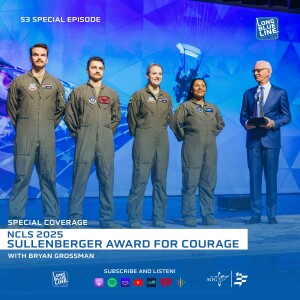
Thursday Mar 13, 2025
Thursday Mar 13, 2025
The Association of Graduates and Air Force Academy Foundation just dropped a special episode of Long Blue Leadership, featuring our continuing coverage of the 32nd National Character and Leadership Symposium.
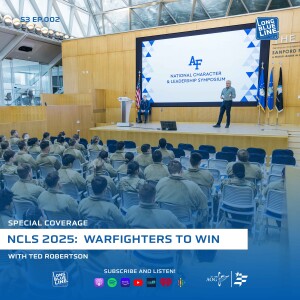
Tuesday Mar 04, 2025
Tuesday Mar 04, 2025
In this special episode of Long Blue Leadership, we present our Long Blue Line Podcast Network coverage of National Character and Leadership Symposium 2025.

Monday Mar 25, 2024
Monday Mar 25, 2024
The Long Blue Leadership team was in attendance at the 2024 National Character and Leadership Symposium and interviewed several NCLS speakers.